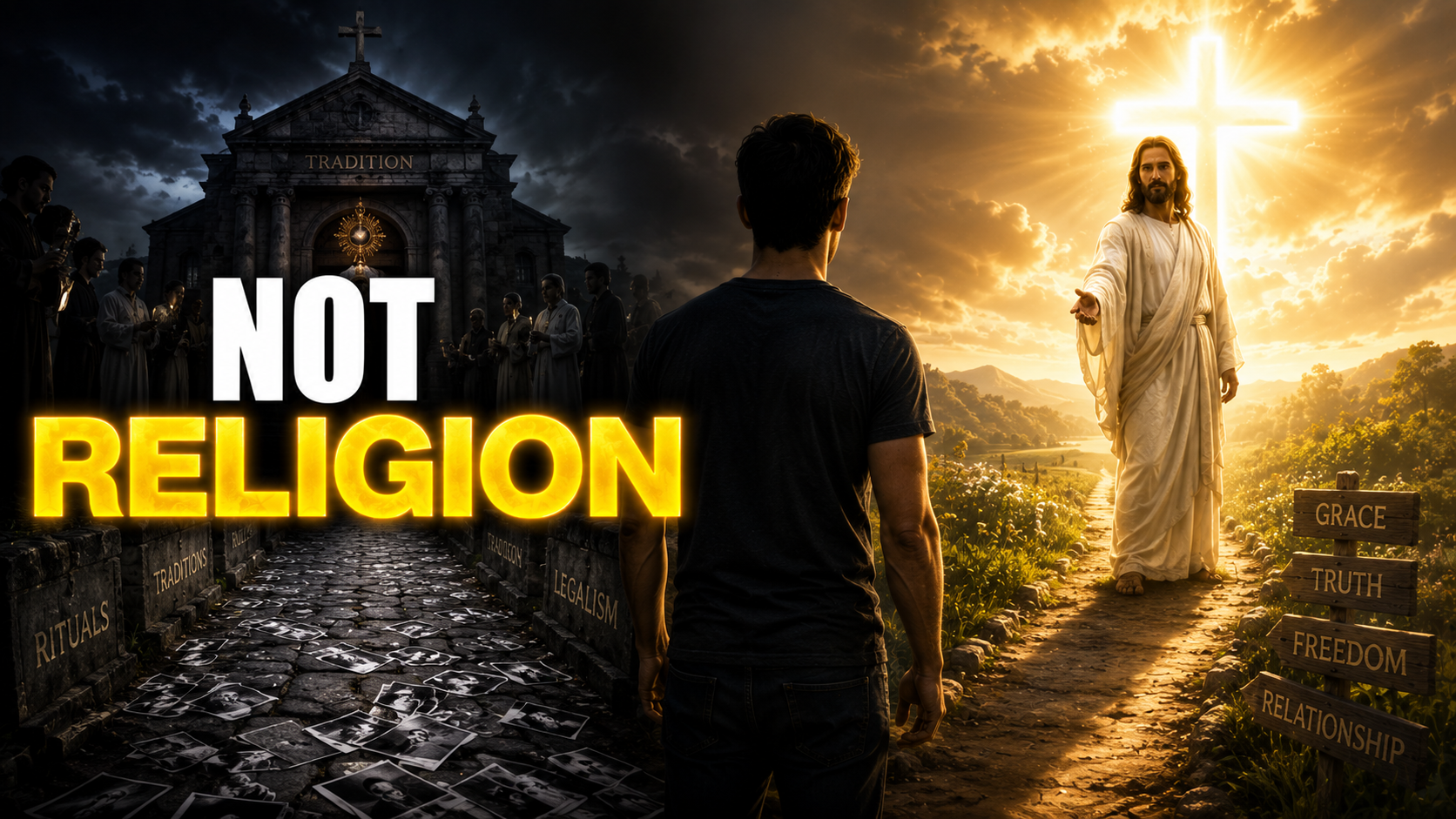
6 Signs You’re Not Just Following Religion — But Following Christ
6 Signs You’re Not Just Following Religion — But Following Christ
It is entirely possible to spend your whole life sitting in church pews, memorizing ancient texts, and climbing the ladders of religious duty, while remaining completely estranged from the Person of Jesus Christ. The human heart possesses an incredible capacity to substitute the exhausting ritual of rules for the transformative power of a relationship. We find comfort in the checklists of tradition because a checklist demands our conformity without ever touching our core. But when Jesus stepped into the pages of history, He didn't come to establish a new cultural institution or to hand us a heavier burden of performance. He came to offer us a living, breathing connection to the Creator—a connection that tears down the heavy scaffolds of external piety and builds a temple of true freedom within the soul. And before we dive in, if this message is already stirring something in you, hit the FOLLOW button and stay connected to God's Word daily, because distinguishing between dead religion and a living Savior is the most critical turning point in your spiritual journey.
The danger of religion is that it can make you look remarkably clean on the outside while leaving you completely hollow on the inside. It is like a beautiful tomb—adorned with marble and gold, yet containing no breath, no heartbeat, and no life. Jesus reserved His sharpest, most devastating rebukes not for the broken outcasts or the obvious sinners of His day, but for the highly religious Pharisees who had mastered the art of the performance while their hearts were miles away from the Father. Religion tells you what to wear, how to talk, and who to avoid; Christ tells you who you are, how you are loved, and how to pour your life out for others. True discipleship is not about striving to reach a God who is standing at the top of a legalistic mountain; it is about resting in a God who climbed down the mountain to rescue you in your brokenness. This message is an invitation to examine the fruit of your devotion with absolute honesty.
We are going to explore the six unmistakable scriptural markers that show you have moved past the surface level of cultural tradition and into the depths of a real relationship with Christ. If you have been feeling tired, burned out, or disconnected from your faith, it may be because you’ve been carrying the weight of a system instead of walking with a Savior. We are going to unpack how the Gospel shifts your perspective from "I have to" to "I get to." This is your moment to drop the heavy baggage of human expectations and step into the light yoke that Jesus promised to those who are weary. Let us open our hearts to the Holy Spirit as we look into the mirror of the Word and discover what it truly looks like to have a faith that is alive, dynamic, and anchored in the living Christ.
Number 1: Moving from Motivation of Guilt to Motivation of Love
The first sign that you have transitioned from dead religion into a living relationship with Christ is a radical shift in your primary motivation. Religion runs on the fuel of guilt, fear, and obligation. It tells you that you must read your Bible, attend services, and give your resources because if you don't, God will be angry with you, or you will lose your standing in the community. But when you are following Christ, the motivation flips completely. 2 Corinthians 5:14 declares, "For Christ’s love compels us, because we are convinced that one died for all." You no longer seek obedience to *get* loved; you seek obedience because you are *already* loved.
When guilt is your primary driver, your spiritual life becomes a series of exhausting transactions. You pray to balance the scales of your failures, and you serve to earn points on a cosmic ledger. But Jesus completely shattered this legalistic system on the Cross when He cried out, "It is finished" (John 19:30). When you understand that your debt has been paid in full, the pressure to perform disappears. Your daily devotional time stops being a box you check to avoid divine disapproval and becomes an appointment with the One who adores you. Love produces a loyalty that guilt could never manufacture.
Think of the difference between a servant and a bride. A servant obeys because they are afraid of losing their position or failing to earn their wage. A bride adjusts her life because she is captivated by the heart of her husband. Religion makes you a nervous servant; Christ makes you a secure child of God. In Luke 7, when a sinful woman washed Jesus’ feet with her tears and wiped them with her hair, Jesus noted that her extravagant devotion was a reflection of her awareness of how much she had been forgiven. She wasn't trying to earn a blessing; she was reacting to a Savior.
If your faith is built on Christ, your standard for doing good is no longer driven by the fear of hell or the desire to maintain a reputation. You look at the sacrifice of Jesus and your heart says, *How can I not give my life to the One who gave everything for me?* This love-driven obedience is resilient. It doesn't fade when nobody is watching, and it doesn't quit when the religious community lets you down. It is an internal fire lit by the grace of God, consuming the cold obligation of the law and replacing it with the warmth of a genuine devotion.
Examine your heart when you serve or pray. Do you feel a heavy sense of "I should, or else," or a joyful sense of "Lord, I love You"? The presence of love as your primary motivator is the most foundational evidence of a living connection to the Vine. When you stop working *for* God and start walking *with* God, the exhaustion of religion is replaced by the rest of the Gospel.
Number 2: Evaluating Your Secret Life Over Your Public Show
The second major indicator of a true follower of Christ is where they focus their spiritual energy. A religious system is obsessed with the external—the clothes you wear, the vocabulary you use, and the public positions you hold. But Jesus consistently directed His attention to the hidden chambers of the soul. In Matthew 6, He gave a series of counter-cultural commands regarding prayer, giving, and fasting, repeatedly saying, "Do not be like the hypocrites, for they love to pray standing in the synagogues and on the street corners to be seen by others... But when you pray, go into your room, close the door and pray to your Father, who is unseen."
If this message inspires you, don't forget to FOLLOW for more Bible insights every week. A religious person needs an audience to sustain their spirituality; a follower of Christ is satisfied with the audience of One. Your true spiritual maturity is not measured by the prayers you speak in public, but by the conversations you have with God in the dark. It is measured by the thoughts you entertain when you are alone, the integrity you maintain when no one can catch you, and the generosity you practice when your name will never be printed on a plaque. Christ changes your character from the inside out, while religion merely polishes the exterior.
Jesus compared the Pharisees to "whitewashed tombs"—beautifully painted on the outside, but full of dead men's bones on the inside (Matthew 23:27). It is incredibly easy to learn the "Christian dialect," to lift your hands during a song, and to nod at a sermon, while harbor-ing bitterness, lust, or greed in your heart. But when you are following Christ, you become deeply concerned with internal alignment. You find yourself praying Psalm 51:6: "Yet you desired faithfulness even in the womb; you taught me wisdom in the secret place." You care more about God seeing a clean heart than the world seeing a clean uniform.
This internal focus changes how you handle your failures. A religious person is devastated by public exposure because it destroys their image. A follower of Christ is broken by secret sin because it disrupts their intimacy with the Father. You stop hiding your flaws from God behind a wall of religious activity and start bringing your mess into the light of His grace for real healing. Your hidden life becomes a place of radical honesty, where you drop the mask of perfection and allow the Holy Spirit to perform real, deep-level surgery on your soul.
Look at your spiritual disciplines over the last month. If your private prayer life, your secret Bible study, and your anonymous acts of kindness outweigh your public religious performances, your faith is anchored in a real relationship. You are not living for the applause of the stands; you are living for the smile of the King. When your secret place is full of life, your public fruit will be undeniable.
Number 3: A Heart for the Broken Over a Desire for Separation
The third marker of a true disciple is how they interact with the brokenness of the world around them. Religion naturally creates a culture of elite separation. It builds high walls to protect its purity, viewing the struggling, the messy, and the lost as dangers to be avoided or targets to be judged. But when we look at the life of Jesus, we see a holiness that was not fragile. He didn't catch the uncleanness of the leper; His purity healed the disease. He was notoriously labeled by His critics as a "friend of tax collectors and sinners" (Luke 7:34).
If your faith makes you increasingly distant, cold, and arrogant toward those who don't know God, you are following a Pharisaical blueprint, not a Christian one. Genuine tracking with Christ softens your heart toward the broken. You stop seeing people as "moral arguments to be won" and start seeing them as "souls to be loved." You realize that you were once just as lost, just as blind, and just as desperate for grace as the person making a mess of their life in front of you. Humility replaces hostility.
Think of the parable of the Good Samaritan. The priest and the Levite—the professional religious figures—saw the bleeding man on the side of the road and crossed to the other side. They had religious duties to perform, laws of purity to maintain, and a schedule to keep. Their religion insulated them from the pain of humanity. But the Samaritan stopped, got his hands dirty, and paid for the man's recovery. Jesus said *that* was the definition of a neighbor. Christ-following looks like leaning into the mess of humanity with a basin and a towel, not standing at a distance with a clipboard of condemnation.
This doesn't mean you compromise your values or participate in ungodliness. Jesus never lowered the standard of truth, but He always raised the standard of grace. He stood between the adulterous woman and her executioners, protecting her from their stones before He gently told her to go and sin no more (John 8). Religion wants to stone the sinner to preserve the law; Christ wants to save the sinner to fulfill the law. When your heart beats with the compassion of Jesus, you look at the broken world not with anger or fear, but with a deep desire to be an agent of reconciliation.
Evaluate your reactions when you see someone caught in a public lifestyle of sin. Is your first instinct to post a critique, mock their failure, or thank God that you are better than them? Or do you feel a weight of intercession, asking God to meet them in their valley? A shift from a posture of isolation to a posture of incarnation is an absolute sign that the heart of the Shepherd has become your own.
Number 4: Finding Rest in Christ’s Identity vs. Exhaustion in Your Effort
The fourth sign that separates religion from relationship is the state of your spiritual energy. Religion is a relentless taskmaster; it never says, "Enough." There is always another meeting to attend, another rule to keep, and another level of holiness to manufacture. Consequently, religious people are often the most exhausted people in the room, constantly driven by the anxious thought that they haven't done quite enough to keep God happy. But Jesus’ invitation in Matthew 11:28-30 is a direct antidote to this grind: "Come to me, all you who are weary and burdened, and I will give you rest... For my yoke is easy and my burden is light."
If this message inspires you, don't forget to FOLLOW for more Bible insights every week. When you are following Christ, your spiritual life is anchored in *His* performance, not yours. Your identity is fixed in what He did on the Cross, which means you are operating from a position of victory, not fighting for a position of security. This brings a deep, psychological and spiritual rest to your soul. You can work hard, serve dynamically, and give radically—but you do it from a place of fullness, not a place of emptiness trying to fill itself.
The book of Hebrews speaks extensively about entering "God's rest" (Hebrews 4). This rest is the realization that your righteousness is a gift, not a wage. Romans 4:5 says, "However, to the one who does not work but trusts God who justifies the ungodly, their faith is credited as righteousness." A religious mind struggles to accept this because it wants the credit for its efforts. It wants to brag about its fasts, its tithing, and its discipline. But a true follower of Christ is happy to say, "I am nothing without Him; my best days are filthy rags apart from His grace."
This rest changes how you handle seasons of weakness or spiritual dryness. When a religious person hits a wall, they panic because they believe their safety net is their own consistency. When a follower of Christ hits a wall, they lean harder on the unchanging character of God. They understand that their salvation is held by Christ's strong grip, not their weak hold on Him. You stop checking your spiritual pulse every five minutes to see if you are still saved and start looking at the unchanging cross as the guarantee of your security.
Are you spiritually exhausted today? Are you running on the fumes of your own willpower, trying to be the perfect Christian to keep up appearances? If so, drop the burden. Jesus didn't die to make you an employee; He died to make you an heir. When you trade the exhausting resume of religion for the adopted birthright of Christ, you find a peace that no workload can disrupt and a joy that survives your darkest days.
Number 5: Embracing Scriptural Truth Over Cultural Tradition
The fifth sign that your faith is genuinely centered on Christ is a fierce loyalty to the Word of God over the comfort of human traditions. Every religious system eventually develops its own unwritten "handbook"—a collection of cultural preferences, styles, and opinions that are elevated to the same level as divine commands. In Mark 7:13, Jesus confronted the religious leaders of His day for a dangerous trend: "Thus you nullify the word of god by your tradition that you have handed down." A follower of Christ has the discernment to separate the eternal Truth of Scripture from the temporary habits of culture.
A religious person becomes deeply offended when a traditional method is changed, because their security is wrapped up in the *form* of their worship rather than the *Object* of their worship. They will fight over music styles, seating arrangements, or dress codes with more passion than they fight for the souls of the lost. But a true disciple understands that while the Gospel is unchanging, the methods of delivering that Gospel must be flexible enough to reach a changing world. They value the text over the tradition.
This alignment with truth also means you are willing to let the Bible challenge *your* cultural worldview. We live in a society that demands absolute compliance with its shifting moral landscapes. A religious system will often bend the knee to the culture to stay relevant or popular. But a follower of Christ stands firmly on the authority of Scripture, even when it costs them social capital, friendships, or career advancement. They do not edit the hard sayings of Jesus to please an audience; they submit their minds to the wisdom of the Sovereign.
Think of the early disciples. They had to leave behind centuries of deeply ingrained Jewish cultural traditions—such as strict dietary laws and nationalistic boundaries—because the Holy Spirit showed them that Christ had opened the door of grace to the Gentiles (Acts 10). It was painful and uncomfortable, but their love for Jesus forced them to embrace the new frontier of the Gospel over the old comfort of the law. They chose the living voice of God over the echo of antiquity.
Check your spiritual attachments. Are you more loyal to the specific denomination, the specific style of your local assembly, or the opinions of your favorite influencers than you are to the clear commands of the New Testament? When your ultimate court of appeal is the text of Scripture, interpreted through the love of Christ, you are free from the trap of legalistic stagnation. You become a person of depth, anchored in truth, yet fluid enough to move wherever the Spirit blows.
Number 6: Joyful Submission to the Lordship of Christ
The final and most definitive sign that you are following Christ rather than a religious template is your attitude toward His absolute authority over your life. Religion allows you to maintain control. It sets up a boundary line: *If I do these five things, God has to leave me alone in the other areas of my life.* It allows you to keep your career, your relationships, and your pocketbook under your own sovereignty while throwing a few scraps of religious activity to God on Sunday. But following Christ requires absolute, unconditional surrender. It is moving Him from the passenger seat of your life to the throne of your soul.
Jesus asked a cutting question in Luke 6:46: "Why do you call me, ‘Lord, Lord,’ and do not do what I say?" The word "Lord" is not a religious title; it is a declaration of ownership. If He is Lord, He has the right to rewrite your plans, to evaluate your spending, to direct your relationships, and to clean out your thought life. A religious person resents this intrusion and tries to negotiate with God. A follower of Christ embraces His Lordship with a heart of joy, knowing that His will is always good, pleasing, and perfect.
Surrender under a religious framework feels like a loss of freedom—a restriction that cuts you off from life. But surrender under Christ feels like an entry into real freedom. You realize that you were a terrible manager of your own life, and handing the keys over to the Creator is the safest thing you could ever do. When He says, "Forgive that person," you forgive because He is Lord. When He says, "Step out in faith," you move because He is Lord. Your obedience stops being an intellectual debate and becomes a functional reality.
Consider the Apostle Paul's favorite self-description: a "bondservant of Christ Jesus" (Romans 1:1). In the Roman world, a bondservant was someone who voluntarily surrendered their freedom to a master they loved and trusted. Paul didn't see his submission as a prison; he saw it as his highest honor. When your life is fully submitted to Christ, you experience a profound deliverance from the anxiety of self-preservation. You don't have to defend your reputation, build your kingdom, or secure your future—all of that belongs to the Master, and He is infinitely capable of taking care of what is His.
Look at the areas of your life where you currently experience the most friction with God. Is there a relationship you are holding onto that violates His Word? Is there a financial habit you refuse to surrender? Is there an ambition that leaves no room for His kingdom? True discipleship is found in the moments where your will clashes with His will, and you choose to bow. That bow is the signature of a genuine follower—the ultimate proof that you aren't just practicing a philosophy, but are living in subjection to a King.
Conclusion
Religion is an architect of masks, a system that trains you to look like a saint while staying a stranger to grace. But following Christ is a journey of total unmasking, a process where the Holy Spirit pulls down your defenses, clears your vision, and fills your heart with the actual life of God. We have seen that the markers of this living connection are undeniable: moving from the slavery of guilt to the freedom of love, prioritizing the secret place over the public stage, embracing the broken with Christ’s compassion, resting in His finished work, holding the Truth above tradition, and joyfully submitting every area of your existence to His absolute Lordship.
If you have realized today that you have been settling for the dry bones of religion, do not let the enemy condemn you. The door to a living relationship is wide open right now. Jesus is not looking at your failures with disappointment; He is looking at you with the same invitation He gave to the disciples by the sea: "Follow me." You can step off the treadmill of religious performance today and slide your neck into the easy yoke of His grace. Let Him carry the weight of your past, your identity, and your future.
Walk forward from this moment with a renewed perspective. You are not defined by how well you keep a human system, but by how deeply you are kept by a divine Savior. Let your life be a testimony to the world of what a real, vibrant connection to Jesus looks like—a life full of love, radiant with truth, and anchored in an unshakeable peace. You are a child of the Living God, called to walk in relationship with the King of Kings. Rest in His love, stand on His Word, and let His life flow through you to change the world around you.
Before you go, make sure to FOLLOW and subscribe, like this video, and share it with someone who needs encouragement today. And join us next time as we uncover another powerful truth from God's Word.
Community Discussion
Please sign in with Google to share your thoughts.
No comments yet. Be the first to start the conversation!