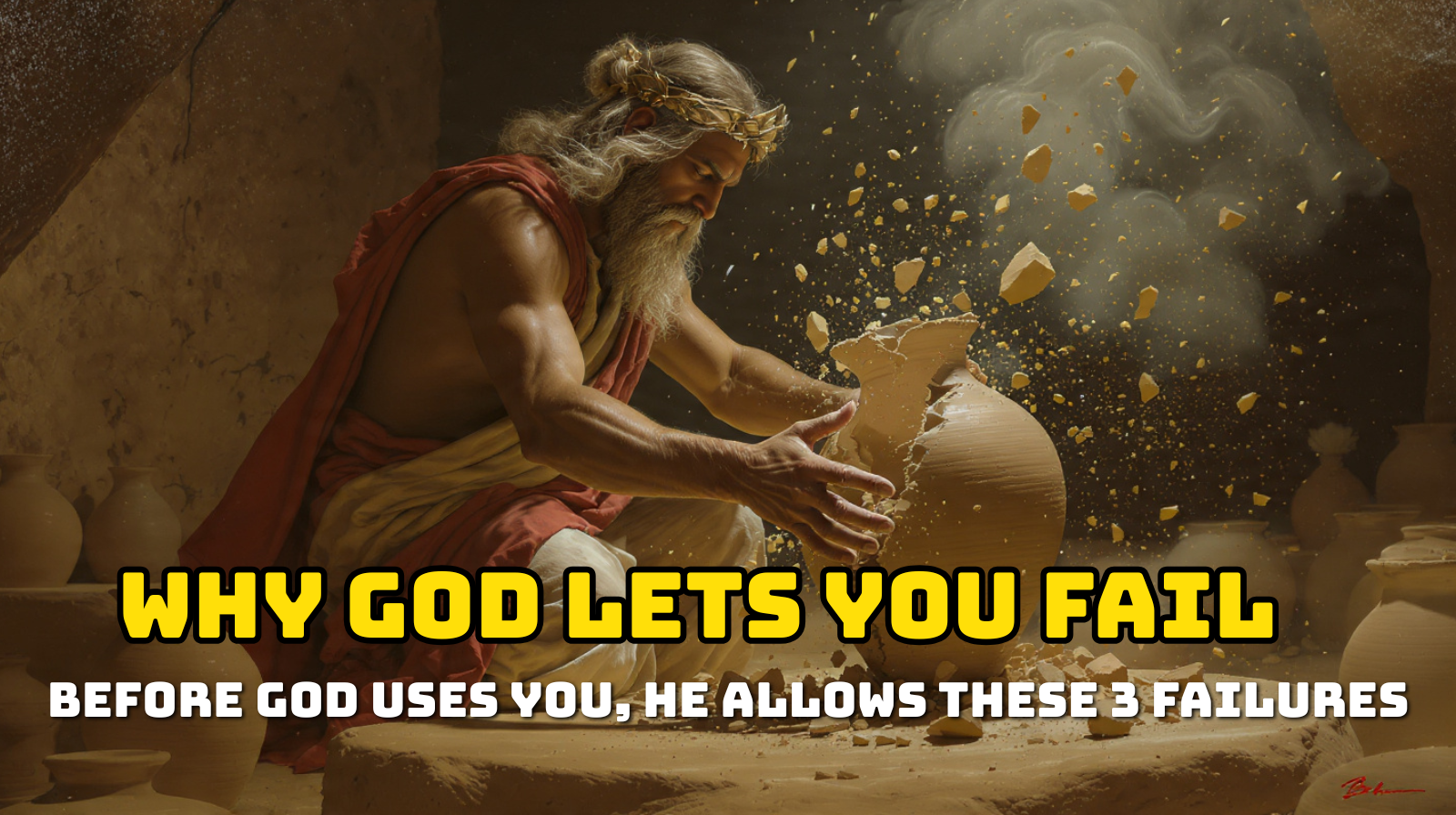
Before God Uses You, He Allows These 3 Failures
Before God Uses You, He Allows These 3 Failures
We love to read the resumes of the spiritual giants. We look at Moses, the deliverer of nations. We look at Peter, the rock of the church. We look at Paul, the architect of the New Testament. We marvel at their power, their miracles, and their unwavering faith. But we often skip the chapter that made them who they were. We skip the chapter on Failure.
There is a pervasive myth in modern Christianity that says if you are called by God, everything will go smoothly. We believe that the anointing is a "Fast Pass" to success. But if you study the Bible carefully, you find the exact opposite pattern. Before God promotes a man or woman to a position of significant influence, He almost always subjects them to a season of crushing failure.
Why? Is He cruel? No. He is careful.
God cannot trust you with His power until He knows you are no longer trusting in your own. He cannot pour His wine into a vessel that is full of itself. He has to empty you first. And the quickest way to empty a human being of pride, self-reliance, and ambition is to allow them to fail.
Today, we are going to walk through the "University of the Wilderness." We are going to identify the three specific types of failure that God allows—even orchestrates—in the lives of His servants. If you feel like you have messed up, hit a wall, or lost everything, take heart. You might just be in the preparation phase for your greatest assignment.
Number 1: The Failure of Self-Reliance (The Moses Failure)
The first failure God allows is the failure of your natural talent. This is the Moses Moment.
In Exodus 2, Moses is 40 years old. He is "powerful in speech and action" (Acts 7:22). He has the best education in the world (Egypt). He knows he is called to deliver Israel. So, what does he do? He tries to fulfill God's call in his own strength.
He sees an Egyptian beating a Hebrew, and he kills the Egyptian. He thinks, "I will save my people with my sword and my strength."
And he fails miserably.
The people reject him. Pharaoh hunts him. Moses has to run for his life into the desert of Midian. He spends the next 40 years herding sheep—a complete failure in the eyes of the world.
Why God Allowed It:
God had to break Moses’ confidence in Moses.
If Moses had delivered Israel at age 40, he would have been an arrogant leader. He would have thought, "I did this because I am a Prince of Egypt."
God had to let him fail so that 40 years later, at the burning bush, Moses would say, "Who am I?" (Exodus 3:11).
God needs you to get to the point where you say, "Lord, I can't speak. I can't lead. I can't do this."
God says, "Perfect. Now that you know *you* can't, watch *Me* do it."
The failure of self-reliance is designed to shift your center of gravity from your ability to His anointing.
Number 2: The Failure of Courage (The Peter Failure)
The second failure is the failure of your commitment. This is the Peter Moment.
Peter was the boldest disciple. He was the one who said, "Lord, everyone else might fall away, but I never will. I will die for You!" (Matthew 26:33).
Peter sincerely believed he was brave. He thought his loyalty was unbreakable.
But God allowed a situation—a charcoal fire in the courtyard of the High Priest—where Peter was stripped of his bravado. A servant girl asked him, "Aren't you one of them?" and Peter crumbled. He denied Jesus three times, even calling down curses.
The rooster crowed, and Peter went out and wept bitterly. He failed the ultimate test of loyalty.
Why God Allowed It:
God had to break Peter’s trust in his own willpower.
Peter was operating on "soulish zeal." He thought he could follow Jesus through sheer grit. But you cannot fight spiritual battles with fleshly determination.
God allowed Peter to fail so he would learn the difference between *commitment* and *surrender*.
A man who has never failed is usually harsh and judgmental of others. But a man who has failed—and been restored—becomes a shepherd of grace.
When Jesus reinstated Peter in John 21, He didn't ask, "Are you strong enough now?" He asked, "Do you love Me?"
God allows you to fail morally or ethically to show you the darkness of your own heart, so that you never preach yourself, but only preach Christ crucified.
Number 3: The Failure of Ambition (The Joseph Failure)
The third failure is the failure of your dream. This is the Joseph Moment.
Joseph had a dream from God. He saw the sun, moon, and stars bowing to him. He knew he was destined for greatness. But he was young, and frankly, a bit annoying about it. He bragged to his brothers.
God allowed that dream to be dismantled. Joseph was thrown into a pit, sold into slavery, falsely accused of rape, and thrown into a dungeon for years.
Every time he tried to get up, he got knocked down.
* He did the right thing with Potiphar’s wife, and he got punished for it.
* He helped the cupbearer, and the cupbearer forgot him.
Why God Allowed It:
God had to kill the "Dreamer" to raise up the "Deliverer."
At 17, Joseph wanted the dream for his own glory. "Look at me, I'm the center of the universe."
By the time Joseph is raised to the palace at age 30, the ambition is dead. When Pharaoh asks him to interpret a dream, Joseph doesn't say, "I can do it." He says, "I cannot do it, but God will give Pharaoh the answer" (Genesis 41:16).
God allows your plans to fail, your business to collapse, or your ministry to stall, to purify your motives. He waits until you don't care about the fame anymore. He waits until you just want to serve people.
When the dream isn't about *you* anymore, God can trust you with the fulfillment of it.
Conclusion
: The Limp of JacobIn Genesis 32, Jacob wrestles with God all night. At the end of the match, God touches Jacob's hip and dislocates it. For the rest of his life, Jacob walked with a limp.
But that was also the moment God changed his name to Israel ("Prince with God").
The greatest men and women of God all have a limp.
* They have a limp in their self-confidence (Moses).
* They have a limp in their pride (Peter).
* They have a limp in their ambition (Joseph).
That limp is not a liability; it is a credential. It proves you have wrestled with God and lost. And in the Kingdom, losing to God is the only way to win.
If you are in the middle of a major failure today, do not despair. You are not disqualified; you are being enrolled in the advanced class.
God is breaking you so He can bless you.
He is subtracting *you* so He can add *Him*.
Stay on the Potter’s wheel. The vessel He is making is worth the pressure.
"The LORD is close to the brokenhearted and saves those who are crushed in spirit." (Psalm 34:18)
Community Discussion
Please sign in with Google to share your thoughts.
No comments yet. Be the first to start the conversation!