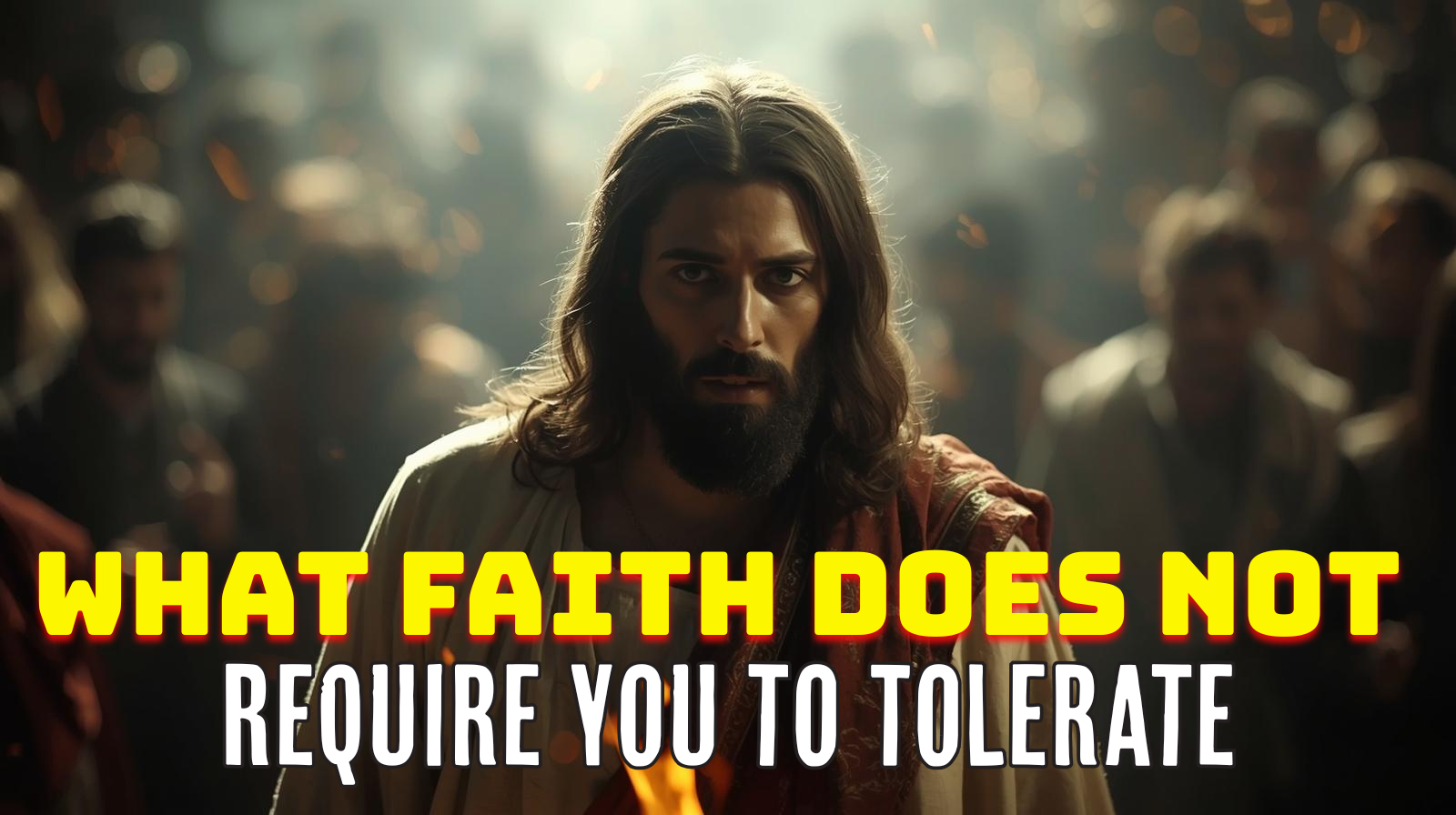
Biblical Boundaries — What Faith Does NOT Require You to Tolerate
Biblical Boundaries — What Faith Does NOT Require You to Tolerate
There is a dangerous misconception that has taken root in the hearts of many believers: the idea that to be a "good Christian" means you must be a doormat. We have confused the command to "turn the other cheek" with a mandate to tolerate chronic abuse. We have confused "forgiveness" with the restoration of trust. We have confused "love" with the enablement of evil. Because of these theological distortions, many of you are living in a state of exhaustion and defeat. You are tolerating behaviors in your life—from friends, family members, or even church leaders—that God never asked you to tolerate. You are keeping the peace at the expense of your own soul, believing that setting a boundary is an act of selfishness or a lack of faith. But let me tell you today: Jesus was the most loving man who ever lived, and yet, He had boundaries of steel. He did not let people manipulate Him. He did not let people distract Him. He walked away from crowds, He rebuked religious bullies, and He refused to entrust Himself to those whose hearts were untrustworthy. If your version of Christianity requires you to lose your dignity, your safety, or your sanity, it is not the Christianity of the Bible. It is a counterfeit religion of codependency. God is a God of gates and walls. He has boundaries around His presence, and He expects His children to have boundaries around their hearts. And before we dive in, if this message is already stirring something in you, hit the subscribe button and stay connected to God's Word daily, because we believe that truth sets us free. Today, we are going to clear the fog. We are going to look at seven specific things that faith does *not* require you to tolerate. We are going to give you the biblical permission slip to say "No," to walk away, and to close the door on toxicity. It is time to stop apologizing for protecting the temple of the Holy Spirit—which is you.
The concept of a boundary is deeply biblical. Proverbs 25:28 says, "A man without self-control is like a city broken into and left without walls." In ancient times, a city without walls was defenseless. It was a victim waiting to happen. God does not want your life to be a city without walls. He wants you to have gates—things you open to let the good in, and things you shut to keep the bad out. Setting a boundary is not an act of hate; it is an act of stewardship. You are the steward of your heart, your time, your energy, and your body. If you allow these things to be trampled, stolen, or abused, you are not being "nice"; you are being a poor steward.
Furthermore, tolerating evil does not help the evildoer. When you allow someone to repeatedly sin against you without consequence, you are not showing them grace; you are helping them destroy themselves. You are becoming an accomplice to their character dysfunction. Sometimes, the most loving thing you can do is to close the gate, to say "Stop," and to let them feel the weight of their own choices. Galatians 6:7 says, "Do not be deceived: God is not mocked, for whatever one sows, that will he also reap." When we intervene to stop people from reaping what they sow, we are mocking God. We are trying to be more merciful than the Almighty. Today, we will learn how to step out of the way and let God deal with the behavior we have been tolerating for too long.
Number 1: Chronic Disrespect and Reviling
Faith does not require you to tolerate chronic disrespect. There is a difference between a person having a bad day and a person who has a bad character. The Bible speaks of "revilers"—people who use verbal abuse, scorn, and insults to belittle others. 1 Corinthians 5:11 actually instructs believers "not to associate with anyone who bears the name of brother if he is... a reviler." Paul says, "Do not even eat with such a one." This is a boundary.
Jesus did not stay where He was not honored. In Nazareth, His own hometown, the people disrespected Him. They questioned His legitimacy and tried to throw Him off a cliff. What did Jesus do? He "passed through their midst and went away" (Luke 4:30). He didn't stay and argue. He didn't try to prove His worth. He left. He took His presence where it was celebrated, not where it was tolerated.
If you are in a relationship—friendship, dating, or even family—where you are constantly belittled, mocked, or treated with contempt, you are under no biblical obligation to stay and take it. Proverbs 22:10 says, "Drive out a scoffer, and strife will go out, and quarreling and abuse will cease." Notice the action verb: *Drive out*. You are allowed to remove the source of the disrespect from your inner circle. Your dignity is a gift from God; do not let anyone trample it in the name of "love."
Number 2: Unrepentant Betrayal (The difference between Forgiveness and Trust)
This is where many Christians get stuck. We are commanded to forgive 70 times 7. That means we must release the debt and let go of bitterness every single time. However, faith does *not* require you to trust someone who is unrepentant or unsafe. Forgiveness is a gift you give freely; trust is a currency that must be earned.
If someone repeatedly betrays you—lies to you, steals from you, cheats on you—and shows no genuine fruit of repentance, you are not required to give them access to your heart again. Proverbs 25:19 says, "Trusting in a treacherous man in time of trouble is like a bad tooth or a foot that slips." It’s painful and useless. God does not ask you to walk on a broken foot.
John 2:24 says, "But Jesus on his part did not entrust himself to them, because he knew all people." Jesus loved them, died for them, and forgave them, but He did not *entrust* Himself to them. You can love someone from a distance. You can forgive someone while changing the locks on your door. Do not let anyone guilt you into restoring a relationship with a person who is still holding the knife they stabbed you with. Reconciliation requires two people; forgiveness only requires one. You do your part (forgive), but if they don't do theirs (repent), the boundary stands.
Number 3: Spiritual Manipulation and Control
Faith does not require you to tolerate spiritual manipulation. This occurs when someone uses God’s Word, their "spiritual authority," or religious guilt to control your life. This is the spirit of the Pharisee. They tie up heavy burdens and lay them on men's shoulders. They say, "God told me you should do this," or "If you leave this church, you are rebelling against God." This is spiritual witchcraft.
Galatians 5:1 says, "For freedom Christ has set us free; stand firm therefore, and do not submit again to a yoke of slavery." You are called to freedom, not to be the puppet of a controlling leader, spouse, or parent. The Holy Spirit leads by peace and conviction, not by fear and coercion. If you feel suffocated, controlled, or fearful in a religious environment, that is not the Cross; that is a cage.
Jesus hated this. He rebuked the religious leaders who devoured widows' houses and made long prayers for show. You have the right to question. You have the right to leave. You have the right to say, "That does not align with Scripture." Do not tolerate a "gospel" that turns you into a slave of men. You were bought with a price; do not become bondservants of men (1 Corinthians 7:23).
Number 4: The Exploitation of Your Generosity
Christians are called to be generous. We are called to give to the poor and help those in need. But faith does not require you to tolerate exploitation. There are people who are "takers." They are parasites. They will drain your bank account, your energy, and your time, and they will never take responsibility for their own lives. They use your "Christian guilt" to manipulate you into funding their dysfunction.
2 Thessalonians 3:10 is a boundary verse: "If anyone is not willing to work, let him not eat." Paul was dealing with lazy believers who were mooching off the church. He drew a hard line. He said, "Stop feeding them." Why? Because feeding them was crippling them. It was keeping them from maturity.
You are not the Savior. If your help is hurting them—if your money is funding their addiction, or your "bailing them out" is preventing them from hitting rock bottom—then the most biblical thing you can do is close your wallet. This is not being stingy; it is being wise. Stewardship means investing God's resources where they will bear fruit, not pouring them into a hole of irresponsibility.
Number 5: Constant Negativity and Gossip
Faith does not require you to be the garbage dump for everyone else’s negativity. We often think that being a "good friend" means listening to someone complain, gossip, and slander for hours on end. We call it "bearing one another's burdens." But there is a difference between a burden (a heavy load of life) and a pile of trash (toxic speech).
Proverbs 20:19 warns, "Whoever goes about slandering reveals secrets; therefore do not associate with a simple babbler." Do not associate. That is a boundary. If someone constantly poisons your spirit with gossip about others, complaining about the church, or cynical negativity, you are allowed to walk away. You are allowed to say, "I'm not comfortable discussing this."
Your ears are gates to your soul. If you let people dump trash in your ears, your spirit will get sick. You will become cynical. You will lose your joy. Guard your ear-gate. Distance yourself from the "angry man" lest you learn his ways (Proverbs 22:24). You are responsible for keeping your heart pure, and that means limiting your exposure to pollution.
Number 6: Pearls Before Swine (Wasted Wisdom)
Jesus gave a very strange command in Matthew 7:6: "Do not give dogs what is holy, and do not throw your pearls before pigs, lest they trample them underfoot and turn to attack you." This is a boundary on your words and your wisdom. There are some people who do not want the truth. They only want to argue. They want to mock. They want to drain you.
Faith does not require you to keep explaining yourself to someone who is committed to misunderstanding you. It does not require you to keep sharing your heart with someone who tramples on your feelings. When you realize you are dealing with a "swine" spirit—someone who has no value for the treasure you are offering—you are commanded to stop.
Stop casting your pearls. Stop trying to convince them. Stop looking for validation from them. Save your energy for the people who are hungry. Save your wisdom for the people who will listen. It is not unloving to silence your voice in the presence of a mocker; it is an act of dignity. Jesus stood silent before Herod. He knew Herod just wanted a show, so Jesus gave him nothing.
Number 7: The Destruction of Your God-Given Purpose
Finally, and most importantly, faith does not require you to tolerate anyone or anything that actively destroys your ability to fulfill your God-given purpose. You were created for a reason. You have a race to run. If a relationship, a job, or a commitment is so toxic that it is destroying your mental health, your physical health, or your spiritual vitality, it has become an idol of destruction.
Hebrews 12:1 says, "Let us also lay aside every weight, and sin which clings so closely, and let us run with endurance the race that is set before us." Note that "weights" are different from "sins." A weight might be a person who is just "heavy." They drag you down. They distract you. They extinguish your fire. The Bible says: *Lay it aside.*
You cannot run your race carrying a dead weight. You cannot fly if you are tied to a rock. God will never ask you to stay in a situation that murders the destiny He placed inside you. He is the God of life. If you are dying on the vine, check the soil. You may need to transplant yourself. Your fruitfulness matters to God.
Conclusion
We have looked at the seven boundaries: Refusing disrespect, withholding trust from the unrepentant, rejecting spiritual control, stopping the exploitation of generosity, silencing the gossip, saving your pearls, and protecting your purpose. These are not unchristian acts; they are acts of spiritual maturity.
If you have been a city without walls, feeling overrun and exhausted, today is your day to rebuild. Pick up the bricks. Set the gates. It will feel uncomfortable at first. People will get angry when you stop letting them use you. That’s okay. Their anger is just proof that the boundary was necessary.
Stand firm. You are a child of the King, not a doormat for the world. Guard your heart, for it is the wellspring of life. Walk in love, yes, but walk in truth and wisdom too.
Before you go, make sure to subscribe, like this video, and share it with someone who needs encouragement today. And join us next time as we uncover another powerful truth from God's Word.
Community Discussion
Please sign in with Google to share your thoughts.
No comments yet. Be the first to start the conversation!