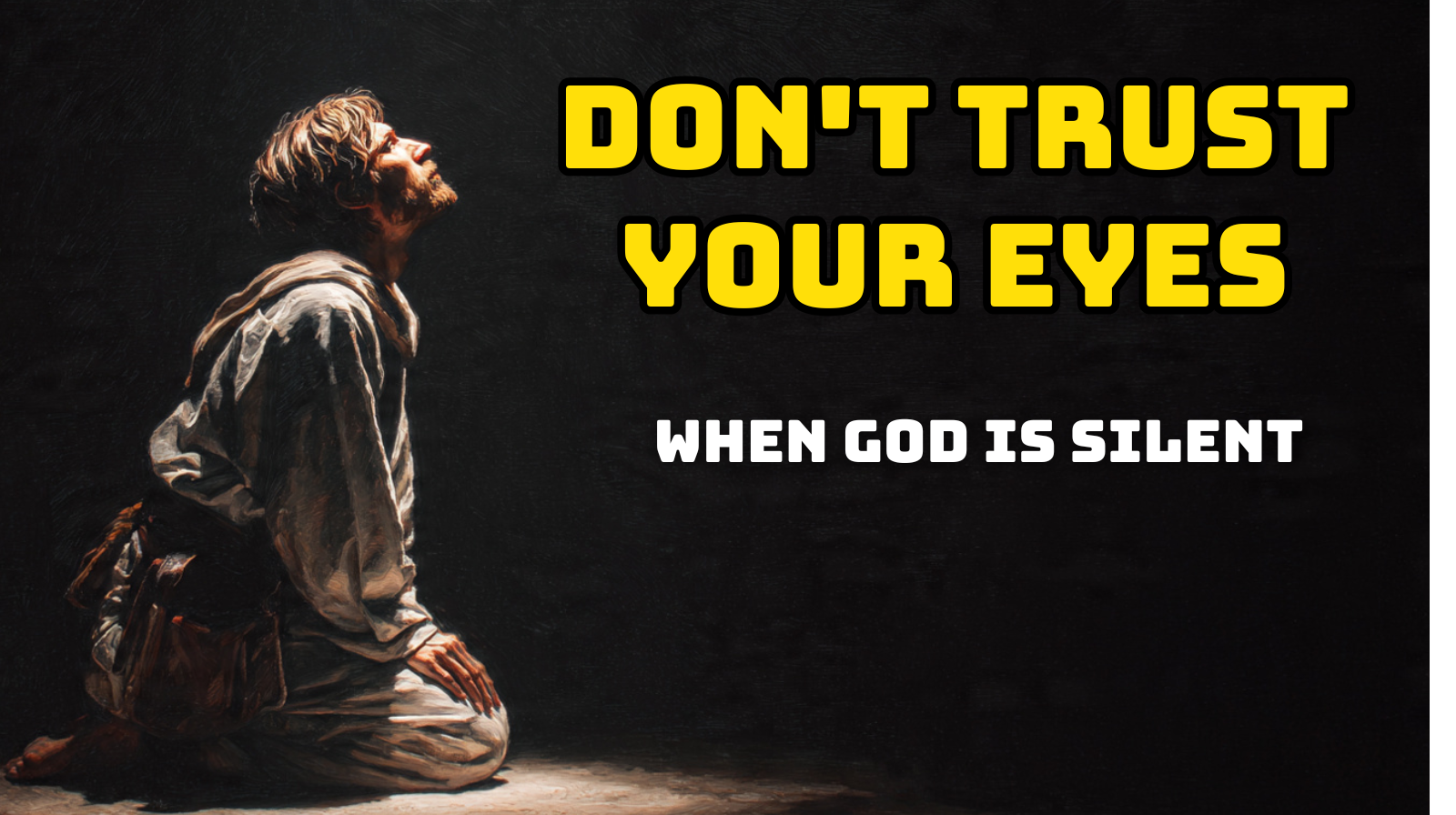
Faith Isn’t About Seeing — It’s About Believing the Light Exists
Faith Isn’t About Seeing — It’s About Believing the Light Exists
It is the defining struggle of the human soul. It’s the prayer whispered into a dark, silent room. It’s the cry of the heart in the middle of a trial that seems to have no end. "God, where are You? If You're really here, just show me a sign. Just let me see what You are doing." We are a people of the senses. We are wired to trust what we can see, what we can touch, and what we can prove. We live by evidence. And then, we are called to a Christian walk that is built on the one thing that defies all of that: Faith. We are asked to trust an invisible God with our visible problems. We are asked to walk in a light we cannot see, while surrounded by a darkness that we can feel in our very bones. And before we dive in, if this message is already stirring something in you, hit the subscribe button and stay connected to God's Word daily, because this is the very anchor of our salvation.
This tension is the central crisis of our faith. We want to see the outcome. We want to see the solution. We want to see the reason for our pain. We want to see the path through the wilderness. But God, in His infinite and often maddening wisdom, does not show us the destination; He asks us to trust the Guide. This is the great pivot of spiritual maturity. Faith is not about "seeing is believing." Faith is "believing is seeing." It is a fundamental shift in which reality you trust more: the temporary, chaotic reality you see with your physical eyes, or the eternal, unshakeable reality you "see" with your heart.
The title of this message is the secret. "Faith isn’t about seeing—it’s about believing the Light exists." It is the settled, unshakeable, and often defiant conviction that God is good, God is present, God is working, and His promises are true, even when every single piece of sensory evidence in your life screams the opposite. It is the ability to stand in the pitch-black-tomb of your circumstances, with the stone rolled in front, and still believe in the resurrection, because you know the One who is the Light. Today, we are going to dismantle our reliance on sight and build, brick by biblical brick, an unshakeable faith that is anchored in the unseen.
Number 1: The Evidence of Things Not Seen
If we are to build a faith that doesn't rely on sight, we must first go to the definitive, foundational biblical definition of faith itself. The author of Hebrews, in chapter 11, verse 1, gives us this powerful, timeless description: "Now faith is the substance of things hoped for, the evidence of things not seen." This one verse is everything. We must break it down, because it is the very constitution of the Kingdom of God. It's not a suggestion; it's a spiritual law, like gravity.
First, "Faith is the substance of things hoped for..." The Greek word for "substance" is hypostasis. This is not a "wishful thinking" word. It is a legal and financial term. It means "a title-deed," "proof of ownership," or "the legal document that proves you own a property." Think about that. Faith is not just "hoping" you'll get the property one day. Faith is the title-deed. It is the proof of ownership, handed to you by God, for a promise you have not yet moved into. Your physical eyes look at your life and say, "This property is a wasteland. It's barren. There's nothing here." But faith holds up the hypostasis, the title-deed signed in the blood of Jesus, and says, "No, I own this. The promise of healing is mine. The promise of peace is mine. The promise of provision is mine. I may not have possession of it yet, but I have ownership of it."
Second, "Faith is the evidence of things not seen." The Greek word for "evidence" is elenchos. This is a legal term used in a courtroom. It means "a conviction," "a proof," "the unshakeable argument that convinces a judge." Faith, therefore, is the conviction in your heart that serves as the "evidence" for a case you cannot physically see. The devil, the "accuser," is the prosecuting attorney. He stands before you and says, "Look at the evidence! Your bank account is empty. Your body is sick. Your family is broken. You are guilty, you are hopeless, you are defeated. I have the facts!" And all of his "facts" are based on the seen world.
But faith, empowered by the Holy Spirit, is the defense attorney that stands up and says, "Objection. You are only presenting the temporary, visible evidence. I submit the superior evidence, the elenchos, the conviction of the unseen." Faith presents the evidence of what God has said. "The evidence I submit is 1 Peter 2:24, 'By His stripes we are healed.' The evidence I submit is Philippians 4:19, 'My God will supply all my needs.' The evidence I submit is Romans 8:38, 'Nothing can separate us from the love of God.'" Faith is the profound, spiritual logic that says, "God's unseen, eternal Word is more real than my seen, temporary problem."
This is why faith isn't "blind." That's a lie from the world. Faith is not "blind faith." Faith is, in fact, the only true sight. It is the ability to "see" the spiritual reality, the original reality, which is more real and more solid than the physical, shadow-reality we live in. We get this backward. We think "seeing is believing." We think the physical world is "real" and the spiritual world is "maybe." God says the exact opposite. The spiritual world is the true, unshakeable substance. The physical world is the temporary, fading shadow. Faith is the gift that God gives us to see correctly. It is the ability to see the Light of His eternal Word, rather than just the shadows of our current circumstances.
Number 2: Believing the Character of the Light-Giver
If our faith cannot be based on what we see in our situation, it must be anchored to something that does not change. If we build our faith on our feelings, we will be unstable, because our feelings are a rollercoaster. If we build our faith on our circumstances, we will be unstable, because our circumstances are a hurricane. Our faith must be anchored in the one, single, unshakeable, eternal constant in the universe: the very character of God.
We must believe in the Light-Giver, even when we cannot see the light. The author of Hebrews again says, "For he who comes to God must believe that He is, and that He is a rewarder of those who diligently seek Him" Hebrews 11:6. The foundation of faith is not believing that God will do what you want. It is believing that God is who He says He is. That He is good. That He is faithful. That He is sovereign. That He is love.
The entire story of Abraham, the "father of our faith," is a lesson in this. God gave him a promise: "You will be the father of many nations." Then, God let him get old. His wife, Sarah, was barren. His body was "as good as dead" Romans 4:19. All of the seen evidence, all of his sight, told him the promise was impossible. The darkness of his reality was 100% contradictory to the light of God's promise. So what did Abraham do? Romans 4:20-21 says, "He did not waver at the promise of God through unbelief, but was strengthened in his faith, giving glory to God, and being fully persuaded that God had power to do what he had promised."
Abraham's faith was not in the seen his body, Sarah's womb. His faith was in the character of the One who had promised. He was "fully persuaded" that God was not a liar. He was fully persuaded that God was powerful. His faith was in the Light-Giver, not the light. This is our call. When you are in the dark, and you cannot see the solution, you must stop analyzing the darkness and start declaring the character of the Light. You stop praying, "God, show me what You are doing," and you start declaring, "God, I know who You are. I cannot see my way, but I know You are the Way. I do not feel Your presence, but I know You are Immanuel, 'God with us.' I do not see how this will be okay, but I know You are the God who works all things together for good."
This is the anchor for your soul. An anchor is useless in a calm harbor. You only need an anchor when the storm comes, when your "sight" shows you nothing but wind and waves. The anchor of faith does not grab onto the storm the seen; it drops deep, past the chaos on the surface, and grabs onto the bedrock the unseen, which is the unchangeable character of God. Your circumstances are a variable. God's character is a constant. Faith is the choice to anchor yourself to the constant, not the variable. If this message inspires you, don't forget to subscribe for more Bible insights every week.
Number 3: The Blessing for Those Who Have Not Seen
One of the most human, relatable, and instructive moments in all of Scripture is the story of Thomas in John, chapter 20. We call him "Doubting Thomas," which is unfair. We should call him "Honest Thomas" or "Every-Single-One-of-Us Thomas." The other disciples, who had seen the resurrected Jesus, come to him and say, "We have seen the Lord!" And Thomas, who is still deep in the darkness of his grief, who is still processing the trauma of seeing his leader executed, who is still living by sight, says one of the most famous lines in history: "Unless I see the nail marks in his hands and put my finger where the nails were... I will not believe."
His faith was 100% conditional on his sight. He was demanding evidence. He was in the dark and demanding that God turn on the lights so he could see. And Jesus, in His profound, breathtaking grace and mercy, does it. He doesn't rebuke Thomas. He doesn't strike him down. He meets him exactly where he is. A week later, Jesus appears again, walks right up to Thomas, and says, "Put your finger here; see my hands. Reach out your hand and put it into my side. Stop doubting and believe." He gave Thomas the sight he demanded. Thomas, in awe, collapses and makes the greatest confession in the Gospels: "My Lord and my God!"
But then, Jesus does something critical. He has just given Thomas "sight-based" faith, but in the very next breath, He corrects this as the standard. He looks at Thomas and says, "Because you have seen me, you have believed..." And then He says the words that are meant for us. He looks through time, right at you and me, and He says, "...blessed are those who have not seen and yet have believed."
This is the pivot point for the entire New Covenant. Jesus is saying, "The 'Thomas' model of faith is over. The 'I need a sign, I need to see' model is a lower form of faith. I am now passing the torch. I am ascending to heaven. And the 'blessed' ones, the ones who will operate in the true power of the Kingdom, will be the ones who can believe in the Light without ever having seen it. They will believe My Word. They will believe the testimony of the Spirit. They will believe in My resurrection, even though they were not in that room." long-to-break
We are the "blessed ones" Jesus was talking about! You are living in the "blessing" of not-seeing! This may not feel like a blessing. It feels like a curse. But why is it a blessing? Because a faith that is built on sight is the most unstable, fragile faith in the world. What happens when the storm comes and you can't see? What happens when the miracle doesn't come? What happens when the darkness doesn't lift? Your faith crumbles. But a faith that has been trained in the dark, a faith that has learned to believe in the Light without seeing it, is a faith that is unshakeable. It is a faith that does not depend on circumstances. It is a faith that can stand in the middle of the fire, like Shadrach, Meshach, and Abednego, and say, "Our God is able to deliver us... but even if He does not... we will not bow." Daniel 3:17-18. That is the blessing of a faith that is not based on sight.
Number 4: The Lamp That Shines in a Dark Place
So, if we are in the dark, and we are not supposed to trust our sight, and we are called to believe without seeing... what are we supposed to do? How do we navigate? Are we just supposed to stumble around in the pitch black, hoping we don't fall off a cliff? No. God has given us a tool. He has given us a light source, but it is not the one we think.
We want God to give us a giant, Hollywood-style spotlight that illuminates the entire forest, shows us the destination, and reveals every twist and turn of the 5-year plan. We want "sight." But God does not give us a spotlight. He gives us a lamp.
Psalm 119, verse 105: "Your word is a lamp to my feet and a light to my path." This is the key to walking by faith. We must understand the technology the psalmist is talking about. A "lamp" in the ancient world was not a floodlight. It was a small, oil-filled clay dish with a wick. How much light did it give off? Just enough. Just enough to see... your next step. It was a "lamp to my feet." It did not show you what was 100 yards down the road. It did not show you what was around the next bend. It just gave you just enough light to put your foot down in a safe place, right in front of you, without stumbling.
This is how God's Word functions. This is how faith works. God's "Light" His Word is not designed to show you the future that's sight; it's designed to give you guidance for your next step that's faith. We are paralyzed in our darkness because we are waiting to see the final outcome. We are saying, "God, I won't move until You show me the whole plan." And God is saying, "I will not show you the whole plan. I am not a spotlight. I am a lamp. I have given you My Word. And My Word has just enough light for your next step of obedience. Will you trust Me?"
Your "next step of obedience" is the light. You're in financial darkness? The spotlight says, "Show me the winning lottery ticket!" The lamp says, "My light for your feet is 'Owe no man anything' Romans 13:8 and 'Be a cheerful giver' 2 Cor 9:7." Your next step is to make a budget and tithe. You're in relational darkness? The spotlight says, "Show me my perfect soulmate!" The lamp says, "My light for your feet is 'Forgive as you have been forgiven' Eph 4:32 and 'Love your neighbor' Mark 12:31." Your next step is to make that phone call and forgive that person. Stop being paralyzed by the big darkness. Open the Word and look for the small light for your next step. That is how you "walk by faith." You just follow the lamp, one step at a time. If this message inspires you, don't forget to subscribe for more Bible insights every week.
Number 5: We Walk by Faith, Not by Sight
This brings us to the great summary statement of the Christian life, written by the Apostle Paul in 2 Corinthians 5:7: "For we live by faith, not by sight." The KJV says "walk" by faith, which is an excellent translation. This is Paul's entire biography in one sentence. This is a man who was, by all seen evidence, a total failure. He was shipwrecked, beaten with rods, stoned and left for dead, imprisoned, constantly hungry, and rejected by his own people. If Paul "walked by sight," his daily journal would have been one of depression and despair. His "sight" told him: "Your ministry is failing. God has abandoned you. Your life is a waste."
But Paul did not walk by sight. He walked by faith. He walked by the conviction of the unseen reality. What was that unseen reality? He tells us just a few verses later, in 2 Corinthians 6:9-10. This is the "faith vs. sight" collision:
By sight "as unknown,"... by faith "yet well known"
By sight "as dying,"... by faith "and behold, we live"
By sight "as sorrowful,"... by faith "yet always rejoicing"
By sight "as poor,"... by faith "yet making many rich"
By sight "as having nothing,"... by faith "and yet possessing everything."
Paul was a man who lived his entire life in the "blessing of not seeing." He was so convinced of the unseen reality of God's Kingdom that it became more real to him than his physical, "seen" suffering. This is the call. "Walking by faith" is an action. It is a verb. It means you make your daily choices based on your faith, not on your circumstances.
The classic example of this is Peter walking on the water in Matthew 14. Jesus, the Light, is out on the water. Peter, in a moment of incredible faith, says, "Lord, if it's you, tell me to come." Jesus says, "Come." Peter steps out of the boat the seen security and onto the water the unseen possibility. And the Bible says "he walked on the water toward Jesus." As long as he was walking by faith—his eyes fixed on the Light Jesus—he was doing the impossible. He was walking on top of his problem.
But then, the Bible says, "But when he saw the wind..." He switched from "walking by faith" to "walking by sight." He took his eyes off the Light and fixed them on the circumstances the wind, the waves. And what was the immediate result? "He was afraid and, beginning to sink, he cried out, 'Lord, save me!'" The circumstances the wind were just as real when he was walking as they were when he was sinking. The Light Jesus was just as real when he was sinking as when he was walking. The only thing that changed was his gaze. The moment he trusted his sight the storm more than his faith the Light-Giver, he began to sink. Your life is the same. Your storm is real. But the Light-Giver is more real. Your "walk" will follow your "gaze."
Number 6: The Hall of Faith - Believing in a Future Light
If we need more proof, if we need a "cloud of witnesses" to testify that this principle is true, the Holy Spirit gives us Hebrews, chapter 11. This chapter is the divine "Hall of Faith," a museum dedicated to men and women who lived exactly by this principle: "believing the Light exists" when they could not see it. Every single hero in this chapter is commended not for their great achievements, but for their great faith in the unseen.
"By faith Noah, being warned by God concerning events as yet unseen, constructed an ark..." Hebrews 11:7. Think about this. Noah was asked to build a giant boat in the middle of a desert, for a phenomenon a global flood, rain that had never happened before. All of his "sight," all of his neighbors, all of his "common sense" screamed that he was a crazy old man. But he believed the Light God's warning more than he believed the darkness his current, dry reality. He walked by faith, not by sight.
"By faith Abraham obeyed when he was called to go out to a place that he was to receive as an inheritance. And he went out, not knowing where he was going." Hebrews 11:8. This is a perfect picture. God, the Light, said, "Go." Abraham said, "Where?" And God said, "I'll be the lamp for your feet. Just go." He had to leave the seen security of his home city, Ur, to chase the unseen promise of a new city. He lived his entire life in tents, "looking forward to the city with foundations, whose architect and builder is God." He lived his seen life based on an unseen home.
"By faith Moses, when he had grown up, refused to be called the son of Pharaoh's daughter, choosing rather to be mistreated with the people of God than to enjoy the fleeting pleasures of sin." Hebrews 11:24-25. Moses had everything he could "see." He had the power, the riches, the pleasures of Egypt. But he traded all of his "seen" treasure for the unseen "reproach of Christ." Why? The chapter tells us. He "persevered... because he saw him who is invisible" Hebrews 11:27. That is the secret of the entire Bible. Moses saw with faith the invisible God more clearly than he saw the visible Pharaoh.
All of these men and women, the Bible says, "died in faith, not having received the things promised, but having seen them and greeted them from afar." They didn't get the "seen" fulfillment. But they "saw" the promise with the eyes of faith. They "saw" the Light from a distance. And that "unseen" Light was enough for them to base their entire "seen" lives on. They prove that it is possible to live and die well, fueled only by a promise from a God you cannot see.
Number 7: The Unshakeable Promise - The Light Shines in the Darkness
This brings us to the final, and most glorious, truth. Our faith is not just "believing the Light exists somewhere." It is not "believing the Light might exist." Our faith is an unshakeable, defiant, joyful declaration that the Light does exist, it is here, and it cannot be defeated.
The Apostle John begins his gospel with one of the most powerful verses in all of Scripture. John 1, verse 5: "The light shines in the darkness, and the darkness has not overcome it." This is the foundation of our hope. Let's look at that last word: "overcome." The Greek word is katelaben. It has a double meaning. It means "to grasp, to comprehend," but it also means "to extinguish, to overtake, to put out."
This verse is the eternal promise of God. It means, first, that the "darkness" the world, our logic, our suffering, the enemy cannot comprehend the Light. The Light of God's plan doesn't make sense to the dark world. The Cross God's greatest victory looked like a defeat total darkness to the world. God's ways are higher than our ways. The darkness cannot understand the Light.
But more beautifully, it means the darkness cannot extinguish the Light. The darkness cannot overcome it. The darkness can be so dark that you cannot see the Light. It can be so thick, so oppressive, so "loud" that you feel like the Light is gone. But your feelings do not determine reality. The truth is that the Light is still shining. The darkness, no matter how powerful it seems, cannot put out the Light. long-Read that again: "The light shines..." present tense "...in the darkness, and the darkness has not..." past tense "...overcome it." The victory is already won. The Light is Jesus Christ. He went into the darkest place in the universe—the cross, sin, death, and the tomb. And He shone. He rose. He overcame the darkness.
Your faith, then, is not a desperate wish that the light will win. Your faith is a joyful declaration that the Light has won. When you are in your "dark" situation, you are not fighting for victory; you are fighting from victory. You are not praying for the Light to exist; you are thanking the Light for being present, even when you cannot see Him. The darkness is a fact, but it is a temporary fact. The Light is the Truth, and it is an eternal Truth. Your job is to believe the Truth, not the fact. Your darkness, no matter how deep, cannot extinguish the Light of Christ in you or the Light of His promises for you.
Conclusion
We have come on a journey today, from the dark, sight-based world of our senses to the bright, faith-based world of the unseen. We have learned that our entire Christian walk is about believing the Light exists, especially when we cannot see it.
We learned, first, that faith is the "evidence" of things not seen Hebrews 11:1. It is the title-deed to our unseen inheritance. Second, we learned that our anchor is not our circumstance, but the unchangeable character of the Light-Giver Hebrews 11:6. We are to be like Abraham, "fully persuaded" that God is who He says He is.
Third, we learned that we are the "blessed ones" John 20:29. Jesus called us "blessed" because we are the ones who can believe without seeing, building an unshakeable faith. Fourth, we learned that God's Word is the "lamp to our feet" Psalm 119:105. It is not a spotlight for the future, but a lamp for our next step of obedience.
Fifth, we learned that we "walk by faith, not by sight" 2 Corinthians 5:7. This is an action. Our choices must be based on our belief, not our circumstances, just as Peter did when he kept his eyes on the Light. Sixth, we looked to the "Hall of Faith" Hebrews 11 and saw a cloud of witnesses—Noah, Abraham, Moses—who all "saw him who is invisible" and based their entire lives on it.
And finally, we claimed our unshakeable promise from John 1:5: "The light shines in the darkness, and the darkness has not overcome it." The Light Jesus has already won. The darkness cannot extinguish Him.
So I ask you today, where is your focus? Are you staring at the wind and the waves? Are you staring at the darkness? Are you begging God for "sight"? I invite you, today, to stop begging to see and to start choosing to believe. Shift your gaze. Stop analyzing the darkness and start declaring the Light. For He is, He is good, and He is the rewarder of those who diligently seek Him.
Before you go, make sure to subscribe, like this video, and share it with someone who needs encouragement today. And join us next time as we uncover another powerful truth from God's Word.
Community Discussion
Please sign in with Google to share your thoughts.
No comments yet. Be the first to start the conversation!