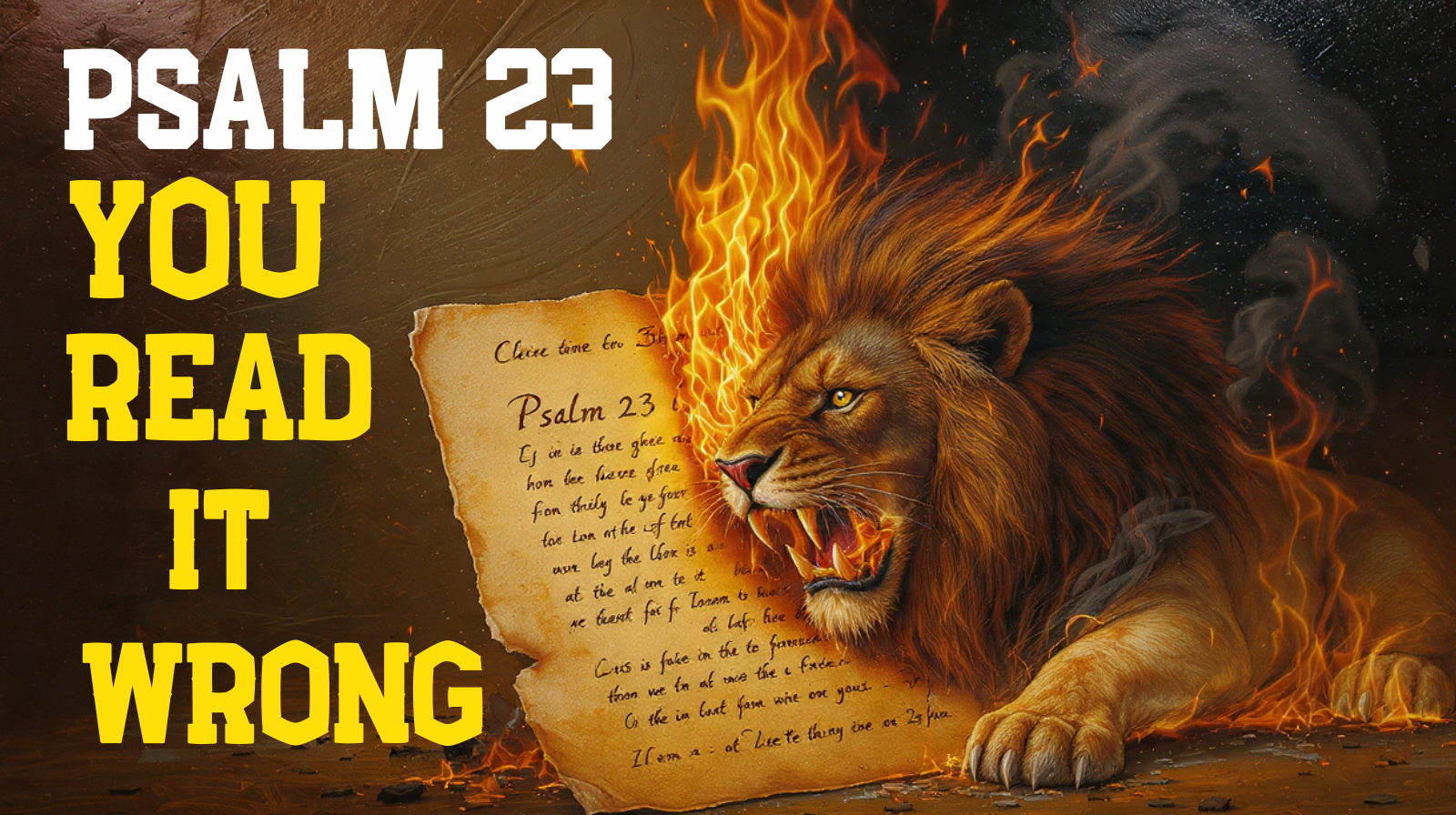
Psalm 23 Is Not What Most People Think — The Hidden Depth You Missed
Psalm 23 Is Not What Most People Think — The Hidden Depth You Missed
If I asked you to close your eyes and picture Psalm 23, what would you see? Most of us immediately envision a peaceful, pastoral scene: fluffy white sheep grazing on emerald green hills, a gentle stream trickling nearby, and perhaps a soft-spoken shepherd cradling a lamb. We associate this passage with funerals, with hospitals, and with moments of quiet desperation. We see it as a soft pillow to rest our heads on when life gets too hard. And while it is certainly a source of comfort, if that is all you see, you are missing the explosive, warrior-like power hidden beneath the surface of these six verses. We have domesticated this Psalm. We have tamed it. We have turned a roaring lion of a text into a greeting card. But David, the man who wrote it, was not a tame man. He was a shepherd, yes, but he was also a giant-slayer, a fugitive, a warrior king, and a man acquainted with the deepest valleys of betrayal and war. When he wrote this, he wasn't sitting in an ivory tower; he was likely reflecting on a life filled with near-death experiences and miraculous deliverances. This isn't just a lullaby for the dying; it is a battle anthem for the living. It is a declaration of dependence in a world that demands independence. It is a roadmap not just for surviving the valley, but for feasting in the middle of the battlefield. And before we dive in, if this message is already stirring something in you, hit the subscribe button and stay connected to God's Word daily, because we believe that truth sets us free. We are going to peel back the layers of tradition today. We are going to look at the Hebrew context, the historical setting, and the rugged reality of shepherding in the Judean wilderness—which is nothing like the green golf courses we imagine. We are going to discover that the Shepherd doesn't just cuddle us; He fights for us. He doesn't just give us a snack; He prepares a banquet right in front of the people who want to destroy us. This is Psalm 23 reloaded. This is the grit behind the grace. Get ready to see the most famous chapter in the Bible with fresh eyes, because what you are about to hear might just change the way you walk through your own dark valley today.
The journey we are about to take transforms our understanding of God from a passive observer to an active, pursuing force in our lives. Many Christians live with a "poverty mindset" regarding God's presence, feeling He is distant or only available when we are perfectly behaved. Psalm 23 shatters that legalism. It shows us a God who is intimately involved in the messy details of our provision, our rest, our paths, and our protection. It moves from the sunny pastures to the deadly ravines and ends in the royal court. It is a progression of spiritual maturity. We start as sheep, but we end as guests in the King's house. We start by eating grass, but we end by drinking wine from an overflowing cup. This is not a static picture; it is a dynamic journey of a soul finding its home in God. Whether you are facing financial lack, a health crisis, or a spiritual attack, this ancient song has a specific, tactical strategy for your victory. It is time to stop reciting it mindlessly and start living it powerfully. Let’s walk through these seven revelations that will shift your perspective from fear to faith.
Number 1: The Warrior Shepherd
The very first line, "The Lord is my Shepherd," is so familiar we often gloss over the radical nature of the metaphor. To understand this, we have to understand what a shepherd was in ancient Israel. In our modern context, we might think of a shepherd as a gentle soul playing a harp on a hillside. But in David's time, shepherding was a gritty, dangerous, dirty, and violent job. The Judean wilderness is not a lush meadow; it is a rugged, arid terrain filled with deep crevices, flash floods, and predators. A shepherd didn't just watch the sheep; he fought for them.
Recall when David was convincing King Saul to let him fight Goliath. What was his resume? He said, "Your servant used to keep sheep for his father. And when there came a lion, or a bear, and took a lamb from the flock, I went after him and struck him and delivered it out of his mouth" (1 Samuel 17:34-35). David engaged in hand-to-hand combat with apex predators. This is the image David has in mind when he calls Yahweh his Shepherd. He is not saying "The Lord is my babysitter." He is saying, "The Lord is my Defender. The Lord is the one who will grab the lion by the beard and strike it down to save me."
This changes how we view our problems. If the Lord is your Shepherd, then you are under the protection of the most powerful Warrior in the universe. A sheep cannot defend itself. Sheep have no claws, no fangs, no venom, and they aren't fast. Their only defense is the Shepherd. When we acknowledge "The Lord is my Shepherd," we are admitting our total inability to save ourselves and our total reliance on His strength. It is a statement of surrender that leads to absolute security. You don't have to fight the wolf; the Shepherd does. You don't have to figure out where the green pastures are; the Shepherd knows.
Furthermore, the personal nature of this claim is staggering. David doesn't say "The Lord is *a* Shepherd" or "The Lord is *Israel's* Shepherd." He says, "The Lord is *my* Shepherd." In a polytheistic world where gods were distant, angry, and transactional, claiming a personal, possessive relationship with the Creator of the stars was revolutionary. It means God looks at you individually. He knows your name. He knows your specific limp. He knows exactly which patch of grass you need. The Creator of the universe has stooped down to take personal responsibility for your survival. When you grasp the weight of this, fear has to leave.
Number 2: The Rebellion of "I Shall Not Want"
The second phrase, "I shall not want," is the antidote to the defining sickness of our modern age: dissatisfaction. We live in a culture that runs on the fuel of "want." We want more money, more followers, more beauty, more success. We are constantly told that we are one purchase away from happiness. But David, a man who had lived in caves and in palaces, declares a spiritual manifesto: "Because the Lord is my Shepherd, I lack nothing."
This doesn't mean "I will get everything I fantasize about." It means "I have everything I need." There is a massive difference. A good shepherd doesn't let his sheep eat poisonous weeds just because the sheep want them. A good shepherd doesn't let the sheep wander off a cliff just because the view looks nice. "I shall not want" is a declaration of trust in the Shepherd's provision. It is saying, "If I don't have it right now, it means either I don't need it, or it's not the right time for it."
This is a profound theological anchor. If you are single and praying for a spouse, but you are still single, can you say, "The Lord is my Shepherd, I shall not want"? It means trusting that His timing is perfect protection. If you are in a season of financial tightness, can you say, "I shall not want"? It forces us to redefine "need." The sheep needs grass, water, and safety. The Shepherd provides that. Often, our misery comes not from a lack of provision, but from a surplus of desire for things that would ultimately harm us.
"I shall not want" is also a weapon against envy. When we look at others—other "sheep" in the pasture—and see them getting green grass while we seem to be on a rocky path, envy rises up. But if the Lord is *your* Shepherd, then He has a custom-designed diet and path for *you*. Looking at another's plate is an insult to your Host. Contentment is not a passive resignation; it is an active, aggressive war against the idol of "More." It is the peace that says, "God is enough." If God is the Shepherd, and He owns the cattle on a thousand hills, then I will never lack anything that is essential for my destiny. If this message inspires you, don't forget to subscribe for more Bible insights every week.
Number 3: The Discipline of Forced Rest
"He makes me lie down in green pastures." Notice the verb: *He makes me*. Sheep are notoriously anxious creatures. Livestock experts tell us that sheep will refuse to lie down if four conditions aren't met: if they are afraid, if there is friction between the sheep, if they are pestered by flies/parasites, or if they are hungry. If any of these are present, the sheep will stand, anxious and ready to bolt. For a sheep to lie down, it requires the shepherd to resolve all these issues.
But sometimes, the sheep is just stubborn. Sometimes, we are so addicted to our busyness, so addicted to our hustle, that we refuse to stop. We think the world will fall apart if we don't check our email one more time. So, the Shepherd has to *make* us lie down. Have you ever been laid off? Have you ever gotten sick and been forced to stay in bed? Have you ever had a door slammed shut? We often see these as attacks from the enemy, but what if it is the Severe Mercy of the Shepherd making you lie down before you burn out?
God knows that we cannot produce fruit if we are constantly running. We need the "green pastures"—the fresh nourishment of His Word—but we can't digest it if we are running. We have to lie down to ruminate. In Hebrew culture, the concept of Shabbat (Sabbath) was a radical act of war against the slavery of Egypt. In Egypt, slaves don't rest. In the Kingdom of God, sons and daughters rest. When God makes you lie down, He is reminding you that you are not a slave to the economy; you are a sheep in His care.
The "still waters" or "quiet waters" mentioned next are crucial because sheep are terrified of rushing water. Their wool is heavy; if they fall into a fast-moving river, they will drown. They won't drink from a torrent. The shepherd has to find a quiet place, or he has to dam up a rushing stream to create a calm pool. God leads us to peace, not chaos. If your life is constantly chaotic, filled with the noise of rushing waters, check who is leading you. The Good Shepherd leads to stillness where the soul can be restored. If you are exhausted today, stop fighting the rest. Let Him make you lie down.
Number 4: The Valley of the Shadow
"Yea, though I walk through the valley of the shadow of death, I will fear no evil." This is the pivot point of the Psalm. In the first three verses, David talks *about* God ("He makes me," "He leads me"). But when he enters the valley, the grammar changes. He stops talking *about* God and starts talking *to* God: "For *You* are with me."
This is a profound truth: We learn theology on the mountaintops, but we learn intimacy in the valleys. It is in the dark, dangerous ravines that we stop analyzing God and start clinging to Him. The "Valley of the Shadow of Death" (or the Valley of Deep Darkness) was likely a real physical place in the Judean wilderness—a narrow canyon with steep cliffs where the sun rarely hit the bottom, and where predators hid in the shadows. It was the most dangerous part of the journey, but it was often the only way to get from the winter pastures to the high summer pastures.
Notice two things. First, David is walking *through* it. He is not setting up camp there. He is not building a house there. The valley is a hallway, not a destination. Many of us get stuck in our trauma or our grief because we stop walking. We think, "This is my life now." No, keep moving. The Shepherd is leading you *through* to the other side.
Second, it is the "shadow" of death. A shadow of a dog cannot bite you. A shadow of a sword cannot cut you. A shadow of a truck cannot run you over. Shadows can terrify us, but they cannot hurt us. Jesus Christ, the Good Shepherd, took the *substance* of death on the cross so that we would only have to face the *shadow*. He absorbed the sting of death. Now, for the believer, death is just a shadow—a transition, not an end.
And why does David fear no evil? Not because the valley isn't scary, but because of the "Rod and Staff." The rod was a club used to beat off wild animals—a weapon of defense. The staff was a long crooked stick used to guide the sheep and pull them out of pits—an instrument of direction and discipline. We often want a God who only has a staff (comfort), but we need a God who has a rod (power/authority). We find comfort in knowing that God is armed and dangerous against our enemies. If this message inspires you, don't forget to subscribe for more Bible insights every week.
Number 5: The Battlefield Banquet
"You prepare a table before me in the presence of my enemies." The scene shifts dramatically here. We leave the pasture and enter the King's court, or perhaps a military encampment. This is the most counter-intuitive verse in the Bible. If I were writing this, I would write, "You take me away from my enemies and we have a nice dinner in a safe bunker." But God does not remove the enemies before He blesses you.
God sets a table—a feast, a banquet—right in the middle of the battlefield. The arrows are flying, the critics are shouting, the devil is roaring, and God says, "Sit down. Let's eat." This is the ultimate "flex" of divine power. It shows that God is so in control that He doesn't even need to silence your enemies to bless you. He can bless you while they watch. In fact, He wants them to watch.
In ancient Near Eastern culture, there was a concept called the covenant of hospitality. If a traveler was fleeing from enemies and entered the tent of a Bedouin sheik, and the sheik served him food, that traveler was under the sheik's protection. The enemies could stand outside the tent and scream, but they could not touch the guest without fighting the host. God is saying, "You are my Guest. Your enemies—sin, death, Satan, anxiety—can stand and watch, but they cannot touch you while you are at My table."
This changes how we handle conflict. We don't need to vindicate ourselves. We don't need to argue with every critic. We just need to sit at the table God has prepared. The table represents communion, supply, and celebration. While the world is in chaos, the Christian has a secret source of nourishment. We feast on the Word, on the presence of Spirit, on the joy of salvation, right in the face of a world that hates us. This is the peace that passes understanding—peace not in the absence of trouble, but in the presence of enemies.
Number 6: The Anointing and The Overflow
"You anoint my head with oil; my cup runs over." This brings us back to the shepherd imagery one last time before merging fully into the Kingly image. In the summer, sheep were tormented by nose flies. These insects would fly up the sheep's nose to lay eggs, driving the sheep insane with pain. The sheep would beat their heads against rocks to stop the buzzing. The shepherd would mix olive oil with sulfur and spices and smear it on the sheep's head. This acted as a repellent. The friction stopped. The buzzing stopped. The sheep could have peace.
The anointing of the Holy Spirit is our repellent against the "buzzing" of the world. When the lies of the enemy, the worries of life, and the accusations of guilt try to burrow into our minds, we need the fresh oil of the Spirit. We need the anointing that seals our mind and brings peace. Without the oil, we go crazy beating our heads against the rocks of life.
But the image is also one of royalty. Kings were anointed with oil. Priests were anointed with oil. God is treating the sheep like a King. And then, "my cup runs over." In the ancient world, if a host filled your cup to the brim, it meant he was generous. But if he kept pouring until it spilled over onto the table and the floor, it was a message: "There is no limit to my favor for you. You can stay as long as you want."
God is not a stingy God. He is a God of "more than enough." Ephesians 3:20 says He is able to do "exceedingly abundantly above all that we ask or think." The overflowing cup is a sign of a life that is not just surviving, but thriving. It is a life that has enough grace for itself and enough to spill over onto others. If your cup is empty, hold it up to the Shepherd. He doesn't measure out drops; He pours rivers.
Number 7: The Hounds of Heaven
"Surely goodness and mercy shall follow me all the days of my life." The English word "follow" is too weak here. The Hebrew word is *radaph*, which means "to pursue," "to chase," or "to hunt down." It is a word usually used for enemies chasing a prey. Pharaoh *pursued* Israel. Saul *pursued* David. But here, David flips the script. It is not enemies chasing him; it is Goodness and Mercy.
Imagine Goodness and Mercy as two sheepdogs, or two bounty hunters sent by God. You cannot escape them. Even when you stumble, God's mercy is hunting you down. Even when you have a bad day, God's goodness is hot on your heels. We often feel like we are chasing God, trying to find Him. But the Gospel truth is that He is chasing us. He is the aggressive party in this relationship.
And where does this pursuit lead? "And I will dwell in the house of the Lord forever." This is the destination. The sheep is no longer out in the wild; the sheep has come Home. To dwell in the house of the Lord means constant, unbroken communion. It means the journey ends in the arms of the Father. It is an eternal promise that begins now. We are the temple of the Holy Spirit; we are already in the House. But one day, we will be there physically, face to face.
The Psalm ends with "Forever." The protection, the provision, the anointing—it isn't a temporary lease. It is an eternal covenant. The Shepherd who walked you through the valley will not abandon you at the gates of eternity. He will walk you right into the Throne Room. This gives us the ultimate security. No matter what happens in the news, no matter what happens in the economy, our end is secure. We are going to the House of the Lord.
Conclusion
We have traveled from the dusty pastures of Judea to the banqueting table of the King. We have seen that Psalm 23 is not a passive poem for the defeated, but a warrior's cry for the dependent. It challenges us to see God not just as a comforter, but as a fighter who engages in combat for our souls. It challenges us to stop striving and let Him make us rest. It challenges us to walk through our shadows with our heads held high, knowing the Host has prepared a table for us in the crosshairs of the enemy.
The secret to Psalm 23 is that it is all about the Shepherd. The sheep has no responsibility other than to stay close. The Shepherd handles the food, the water, the path, the predators, the discipline, and the destination. Your only job is to listen to His voice and follow. If you are carrying the weight of the world on your shoulders today, drop it. You are not the Shepherd. You are the sheep. Let Him do His job. He is good at it. He has never lost a sheep that truly belonged to Him, and He won't start with you.
Let this Psalm be your daily confession. Wake up and say, "The Lord is my Shepherd, I have everything I need." When fear strikes, say, "I will fear no evil, for You are with me." When you feel unworthy, say, "Goodness and mercy are hunting me down." Live in the reality of this text, and you will find a courage that the world cannot shake. You are loved, you are protected, and you are pursued by the Creator of the universe.
Before you go, make sure to subscribe, like this video, and share it with someone who needs encouragement today. And join us next time as we uncover another powerful truth from God's Word.
Community Discussion
Please sign in with Google to share your thoughts.
No comments yet. Be the first to start the conversation!