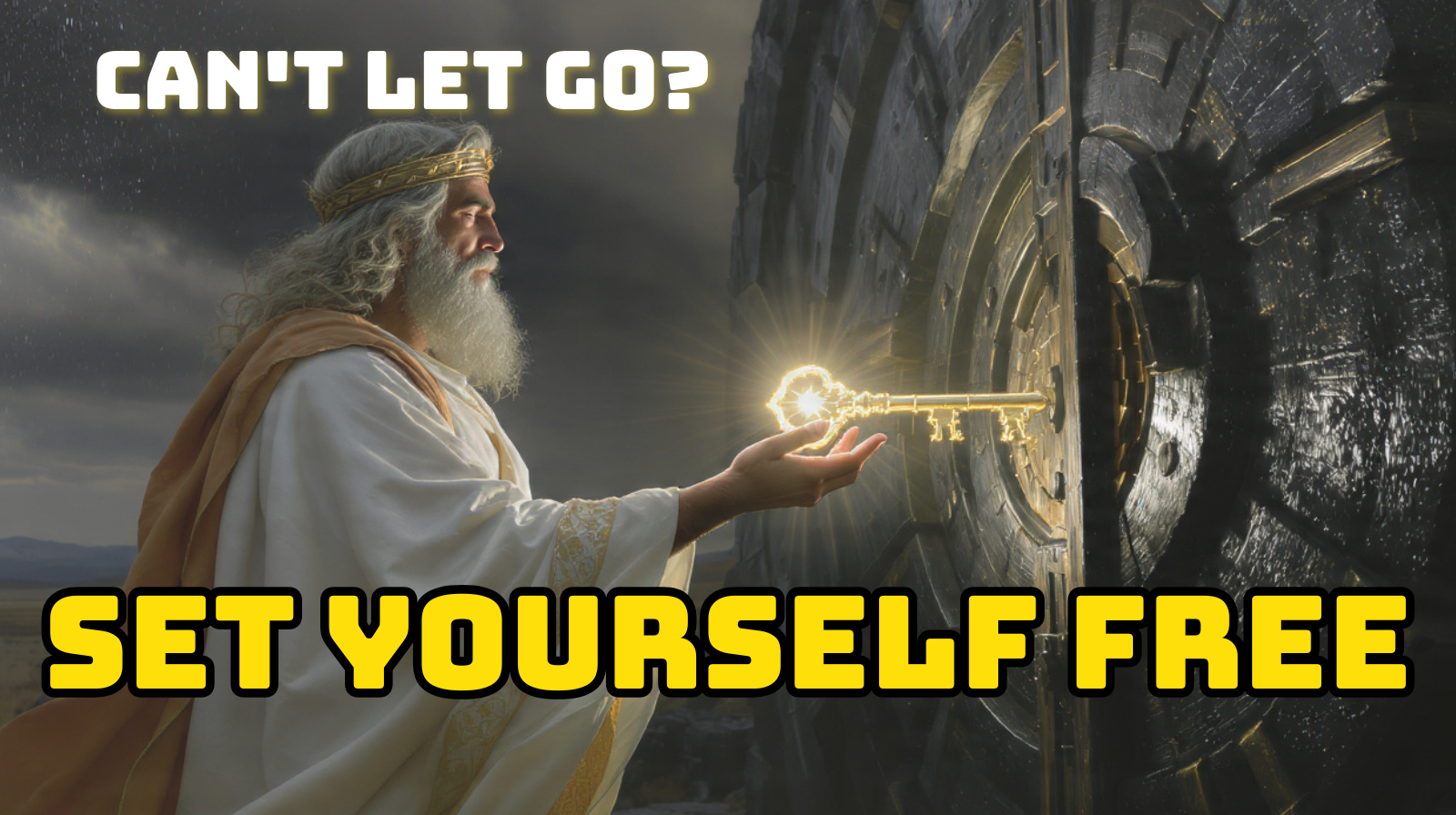
The Battle Behind Why You Can’t Let Things Go
The Battle Behind Why You Can’t Let Things Go
There is a room in your mind that you visit often. It is a courtroom. In this room, you are the prosecutor, the judge, and the jury. You bring up the memories of what they did to you—the betrayal, the harsh words, the abandonment, the unfairness. You replay the evidence over and over again. You make your closing argument. You slam the gavel and declare them "Guilty." And you feel a moment of satisfaction. But then, you realize something terrifying: you are the only one in the room. The person who hurt you is out living their life, sleeping soundly, maybe not even thinking about you. But you are trapped in that courtroom, reliving the pain every single day. You tell yourself you want to move on, but something inside you simply *cannot* let it go. You feel stuck. You feel heavy. And you wonder, "Why am I still carrying this ten years later?"
The world tells you to "just let it go" or "move on," as if it were that simple. But for the believer, the inability to release an offense is not just a stubborn personality trait; it is a spiritual battle. It is a stronghold. The enemy knows that as long as you are holding onto the past, your hands are too full to receive your future. He knows that unforgiveness is the single most effective way to block the flow of God's power in your life. You aren't holding onto the grudge because you are mean; you are holding onto it because you believe it is protecting you. You believe it is the only way to get justice. But God wants to show you a better way.
If you are tired of dragging the heavy luggage of yesterday into your today, this message is your release form. We are going to explore the deep, spiritual reasons why we cling to our pain. We are going to look at the lies we believe about forgiveness, the cost of the "root of bitterness," and the specific biblical key that unlocks the prison door. You don't have to live in the courtroom anymore. You can live in the freedom of the Father's house. And before we dive in, if this message is already stirring something in you, hit the subscribe button and stay connected to God's Word daily, because today is the day you finally drop the weight.
Number 1: The Idol of Justice — Playing God
The primary reason we cannot let things go is that we have a deep, God-given desire for justice. When something is wrong, we want it made right. We want the scales to balance. If they hurt you, they should hurt. If they stole from you, they should pay. This desire is not evil; it is a reflection of God’s character. But the sin enters when we decide that *we* must be the executioners of that justice.
In Romans 12:19, Paul gives a command that chafes against our flesh: "Do not take revenge, my dear friends, but leave room for God’s wrath, for it is written: 'It is mine to avenge; I will repay,' says the Lord." When we hold onto an offense, replaying it and wishing for their downfall, we are essentially saying, "God, I don't trust You to handle this. You might be too merciful. You might let them off the hook. So I will sit in the Judge's seat myself."
We hold on because we are afraid that if we let go, they "get away with it." But biblically, no one gets away with anything. Every sin is either paid for by Christ on the cross (if they repent) or paid for by the sinner in judgment. Justice is inevitable. The battle behind your inability to let go is a battle for control. You are trying to do God's job. Surrender the gavel. Hand the case file over to the Supreme Judge of the Universe. He saw what happened. He kept the receipts. And He knows how to handle it far better than you do.
Number 2: The Identity of the Victim — The Man at Bethesda
Sometimes, we hold onto our pain because we don't know who we would be without it. Our trauma becomes our identity. We become "the divorcee," "the widow," "the one who was abused," "the one who was fired." We wrap ourselves in the story of our victimization because, strangely, it feels safe. It lowers expectations. It garners sympathy.
In John 5, Jesus approaches a man who has been an invalid for 38 years. He is lying by the pool of Bethesda. Jesus asks him a question that seems rude: "Do you want to get well?" Why would He ask that? Of course, he wants to get well! But Jesus knew that after 38 years, the man's sickness had become his lifestyle. The man immediately starts making excuses: "I have no one to help me... someone else goes down ahead of me." He was rehearsing his story of victimhood.
The battle you are facing is an identity crisis. The enemy wants you to identify with what happened *to* you, rather than what Jesus did *for* you. If you let go of the bitterness, you have to stand up. You have to take responsibility for your future. You have to stop using the past as an excuse for your present stagnation. Jesus is calling you to pick up your mat and walk. You are not a victim; you are a victor. But you cannot be a victor as long as you are cuddling your injury.
Number 3: The Lie of Protection — The Wall Around the Heart
We often view our anger and unforgiveness as a shield. We think, "If I stay angry, I stay alert. If I keep this wall up, they can never hurt me again." We equate forgiveness with vulnerability, and vulnerability feels like a death sentence. So, we build a fortress of bitterness. We become cold, cynical, and suspicious. We think we are safe.
But the wall you build to keep the pain out also keeps the love out. It keeps the joy out. It keeps the Holy Spirit out. In C.S. Lewis’s book *The Great Divorce*, he describes hell as a place where people move further and further away from each other because they can't get along. Isolation is not safety; it is hell.
Proverbs 18:19 says, "A brother wronged is more unyielding than a fortified city." You have become a fortified city. But God wants you to be a garden. A garden is open, vulnerable, and fruitful. Yes, a garden can be trampled, but a garden can also grow. A fortress can only defend. The battle here is overcoming the fear of pain. You must realize that God is your Shield (Psalm 3:3), not your anger. Your anger is a false shield that is suffocating you from the inside. It is safer to trust God with your heart than to trust your wall.
Number 4: The Misunderstanding of Forgiveness — Trust vs. Release
A major reason we can't let go is a theological error. We think forgiveness means "reconciliation." We think that if we forgive them, we have to trust them again, let them back into our lives, or pretend nothing happened. And because our survival instinct screams "No! They are dangerous!", we refuse to forgive.
But the Bible separates forgiveness and trust. Forgiveness is a command; trust is something earned. Forgiveness is past-tense (releasing the debt of what happened); trust is future-tense (believing in their behavior going forward). You can forgive someone and still call the police. You can forgive someone and never speak to them again. You can forgive someone and keep the boundary firmly in place.
Jesus commanded us to forgive "seventy times seven" (Matthew 18:22), but He did not command us to entrust ourselves to untrustworthy people. In John 2:24, it says, "But Jesus would not entrust himself to them, for he knew all people." He loved them, He forgave them, but He didn't trust them. When you realize that you can release the debt without reopening the door, the battle becomes much easier. You are simply evicting them from your head, not inviting them back into your house.
Number 5: The Root of Bitterness — The Poisoned Well
Hebrews 12:15 gives us a terrifying warning: "See to it that no one falls short of the grace of God and that no bitter root grows up to cause trouble and defile many." Bitterness is described as a "root." A root grows underground. It is hidden. You might look fine on the outside—you go to church, you smile, you say "Praise the Lord"—but underneath the surface, there is a root system feeding on the toxic waste of the past.
This root "defiles many." Have you ever noticed that when you are bitter at one person, you end up snapping at your spouse? You end up impatient with your kids? You become cynical about your church? The poison doesn't stay in the container. It leaks. It contaminates your entire life.
The battle here is recognizing that the bitterness is hurting *you* more than it is hurting *them*. Nelson Mandela famously said, "Resentment is like drinking poison and then hoping it will kill your enemies." You are the one dying. You are the one losing sleep. You are the one with the ulcers and the anxiety. The enemy wants you to keep the root because he knows it will eventually choke your spiritual life. You must ask the Holy Spirit to pull it up by the root, no matter how painful the extraction is.
Number 6: The Blockage of Grace — The Unmerciful Servant
This is the hardest truth, but the most necessary. Jesus teaches in Matthew 6:15, "But if you do not forgive others their sins, your Father will not forgive your sins." This is a spiritual law. Grace is a flow. It flows from God, into you, and through you to others. If you block the outflow (to others), you block the inflow (from God). You become a stagnant pond.
In the Parable of the Unmerciful Servant (Matthew 18), a man who was forgiven a debt of millions (representing our sin against God) refuses to forgive a debt of a few dollars (representing others' sin against us). The Master is furious and throws him into prison to be tortured. The torment you feel—the anxiety, the lack of peace, the distance from God—is often the spiritual consequence of blocking the flow of mercy.
The battle is a battle for your own freedom. You cannot live under the grace of God while holding someone else under the law of judgment. You have to choose: Do you want to be right, or do you want to be free? Do you want to exact payment from them, or do you want Jesus to pay your debt? You cannot have it both ways. Letting go is an act of spiritual survival.
Number 7: The Exchange at the Cross — Giving It to Jesus
Finally, the ultimate reason we struggle to let go is that we haven't truly brought the hurt to the Cross. We try to "forget" it. We try to "get over" it. But you can't just get over deep trauma. It has to be *placed* somewhere. It has to be transferred.
1 Peter 5:7 says, "Cast all your anxiety on him because he cares for you." The word "cast" means to throw, to transfer the weight. The Cross is the place where God deals with sin—both the sin you committed and the sin committed *against* you. Jesus bore the griefs and carried the sorrows (Isaiah 53:4). He felt the betrayal. He felt the abuse. He felt the injustice.
The battle ends when you stop carrying the pain and physically, spiritually hand it to Jesus. You say, "Lord, this is too heavy for me. I can't fix it. I can't undo it. I can't even forgive them in my own strength. I am giving this hurt to You. You be the Judge. You be the Healer. I resign from the job of managing this offense."
Conclusion
The battle behind why you can't let things go is not just emotional; it is a war for your soul, your identity, and your destiny.
We have seen the Idol of Justice, trying to play God. We have exposed the Identity of the Victim. We have dismantled the Lie of Protection. We have clarified the difference between Forgiveness and Trust.
We have dug up the Root of Bitterness, warned against Blocking Grace, and learned the power of the Exchange at the Cross.
Open your hands. It is safe to let go. Not because they deserve it, but because you deserve to be free. The cage door is open. Walk out.
Before you go, make sure to subscribe, like this video, and share it with someone who needs encouragement today. And join us next time as we uncover another powerful truth from God's Word.
Community Discussion
Please sign in with Google to share your thoughts.
No comments yet. Be the first to start the conversation!