The Verse Most People Misunderstand in the Bible
The Verse Most People Misunderstand in the Bible
We see it everywhere. It is printed on coffee mugs, etched onto jewelry, tattooed on biceps, and written in black marker on the shoes of athletes before the big game. It is the go-to slogan for the underdog, the rallying cry for the ambitious, and the mantra for anyone trying to achieve a massive goal. It is Philippians 4:13: "I can do all things through Christ who strengthens me." We treat this verse like a spiritual blank check. We use it to claim victory in sports, to promise success in business, or to assure ourselves that we will get that promotion, run that marathon, or ace that test. We have turned it into a Christian version of "mind over matter" or a self-help motto sprinkled with a little holy water. We interpret it to mean: "Because Jesus is with me, I can achieve anything I set my mind to."
But what if I told you that this interpretation is not only shallow, but it actually misses the breathtaking depth of what God is actually offering you? What if this verse isn't about achieving your dreams, but about surviving your nightmares? What if it’s not about winning the game, but about having peace when you lose it? The way we commonly use this verse often puts the focus on us—on our achievements, our goals, and our triumphs. But the true context of this verse puts the focus entirely on Him—His sufficiency, His sustainability, and His presence in the darkest holes of human existence. When we strip away the Americanized, success-oriented veneer we have painted over this scripture, we find something far more powerful than a slogan for success. We find an anchor for the soul.
And before we dive in, if this message is already stirring something in you, hit the subscribe button and stay connected to God's Word daily, because today we are going to recover the true power of Philippians 4:13. We are going to take this verse back from the gym walls and put it back where it belongs: in the heart of the suffering believer. We are going to discover that Paul wasn’t talking about becoming a superhero; he was talking about becoming unbreakable. This is a journey into the heart of contentment, and it will change the way you walk through every valley for the rest of your life.
Number 1: The Superman Myth - Deconstructing Our Cultural Lens
To understand the true beauty of this verse, we must first aggressively dismantle the myth we have built around it. We have culturally conditioned ourselves to read the Bible through the lens of individual success. When we read "I can do all things," our minds immediately jump to the "things" we want to do. We fill in the blank. "I can... make a million dollars." "I can... win this championship." "I can... get this house." We make the verse about conquest. We view Christ as the battery pack that powers our ambitions. If we just have enough faith, if we just quote the verse with enough conviction, Jesus will provide the "strength" to make our dreams a reality. This is the "Superman Myth." It suggests that a Christian should always be winning, always be climbing, and always be overcoming obstacles in a blaze of glory.
But this interpretation creates a massive theological crisis when life falls apart. What happens when you quote Philippians 4:13, but you don't get the job? What happens when you pray for healing, claiming you can "do all things," but the sickness stays? What happens when you train for the marathon and break your leg? If we believe this verse is a promise of material or physical success, then failure makes us question God. We think, "Did His strength fail? Did my faith fail?" The Superman Myth sets us up for a fragile faith that shatters the moment God allows us to lose. It turns God into a means to an end, rather than the end Himself. It suggests that the proof of God's presence is our success, rather than our sustenance.
This mindset is not just wrong; it is dangerous. It breeds a sense of entitlement. It makes us think that because we are Christians, life should be easier for us. It aligns the Gospel with the American Dream rather than the Cross of Calvary. The heroes of the faith in the Bible were not people who "won" every time. They were people who endured. They were people who were sawn in two, who were destitute, afflicted, and mistreated (Hebrews 11). Did they lack the strength of Christ? Absolutely not. They had it in abundance. But that strength didn't look like "success"; it looked like faithful endurance. We have to trade our desire for a highlight reel for a desire for a holy resilience. We have to stop using this verse to demand what we want and start using it to receive what we need.
The tragedy of the Superman Myth is that it actually cheapens the power of God. It reduces the Omnipotent Creator to a performance-enhancing drug. It makes Him the wind beneath our wings, helping us fly to our destinations. But God is not interested in helping you build your kingdom; He is interested in you surrendering to His. The "strength" Paul is talking about is not the strength to conquer the world; it is the strength to overcome the world by not being tethered to its definition of success. As we move forward, we need to wipe the slate clean. We need to approach this verse not as people looking for a victory lap, but as pilgrims looking for the strength to keep walking when the road runs out.
Number 2: The Prisoner’s Perspective - The Reality of the Room
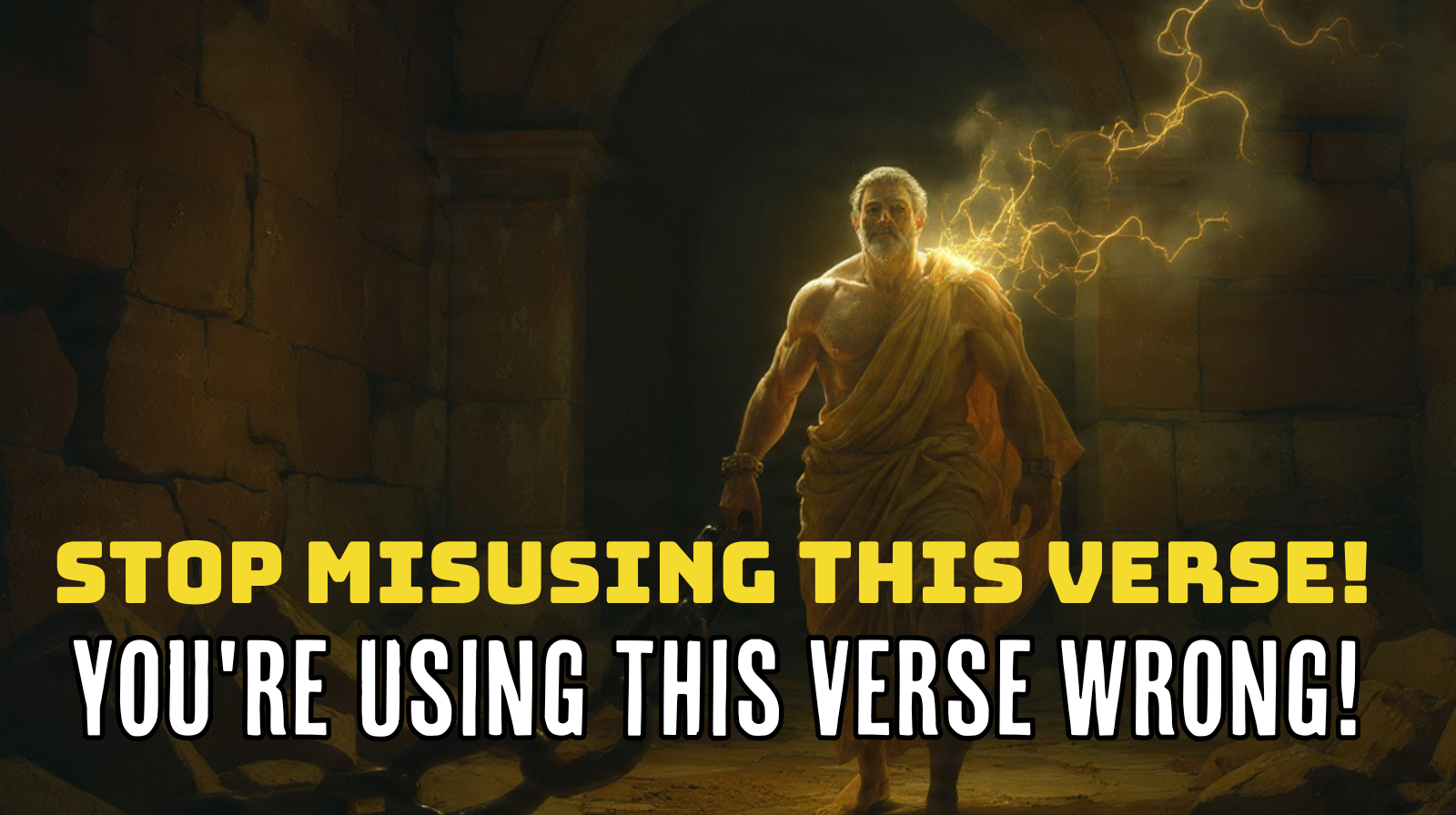
Context is the king of interpretation. To truly grasp the weight of "I can do all things," we have to look at where the man who wrote it was sitting. The Apostle Paul did not write these words from a palace. He didn't write them after winning a gold medal or closing a massive business deal. He wrote the book of Philippians from a Roman prison cell. He was chained to a guard 24 hours a day. He was likely cold, poorly fed, and facing the very real possibility of execution. By every standard of the world, Paul was a loser. He had lost his freedom, his status, his comfort, and his ability to move. If anyone looked like they couldn't do "all things," it was Paul.
Imagine the scene. The damp walls. The smell of a dungeon. The constant clinking of chains. And in the middle of that restriction, Paul picks up a pen and writes a letter that is absolutely overflowing with the word "Joy." He writes about rejoicing. He writes about peace. And he writes, "I can do all things." If this verse meant "I can achieve my dreams," Paul would be a liar. He wasn't achieving his dream of traveling to Spain. He wasn't planting churches freely. He was stuck. So, "all things" clearly cannot mean "anything I want." Paul couldn't walk out of that prison. He couldn't force the Emperor to set him free. The "things" he was referring to had nothing to do with controlling his external circumstances.
This context shifts the verse from a slogan of achievement to a cry of defiance. Paul was looking at his chains and saying, "These chains cannot break me." He was looking at his lack of food and saying, "This hunger cannot starve my spirit." He was looking at the threat of death and saying, "This cannot steal my life." The "all things" Paul was speaking of referred to the incredible array of hardships, trials, and deprivations he was facing. He was saying, "I can endure this prison. I can endure this cold. I can endure this loneliness. I can handle this." If this message inspires you, don't forget to subscribe for more Bible insights every week.
This changes everything for us. It means that this verse is not for the day you get the promotion; it is for the day you get fired. It is not for the day you win the race; it is for the day you can't get out of bed because of depression. It is a verse for the hospital room, the funeral home, and the unemployment line. It is the promise that no matter how small your world shrinks, no matter how high the walls around you get, the strength of Christ is sufficient to keep your soul alive and your joy intact. Paul was proving that his internal reality was more powerful than his external reality. He was a free man in chains because Christ was strengthening him.
Number 3: The Secret of Contentment - The Verses You Skipped
The biggest mistake we make with Philippians 4:13 is reading it in isolation. We rip it out of the paragraph like a fortune cookie. But if we back up just two verses, to verses 11 and 12, the true meaning unlocks like a treasure chest. Paul writes, "I am not saying this because I am in need, for I have learned to be content whatever the circumstances. I know what it is to be in need, and I know what it is to have plenty. I have learned the secret of being content in any and every situation, whether well fed or hungry, whether living in plenty or in want." Then, and only then, does he say, "I can do all things through Christ who strengthens me."
The "all things" refers back to the list he just made: being hungry, being full, having plenty, having nothing. Paul is saying, "I can do these things. I can handle poverty. I can handle wealth. I can handle an empty stomach. I can handle a feast." The verse is actually a summary statement about contentment. It is about the spiritual equilibrium that allows a believer to remain steady when the world is shaking. Paul calls this a "secret" that he had to "learn." It didn't come naturally. He had to go through the school of hard knocks to learn that his joy was not attached to his stuff.
Contentment is one of the rarest commodities in the human experience. We are wired to want more. We are wired to think, "I'll be happy when..." When I get married. When I get the raise. When the kids grow up. When I retire. We live in a state of perpetual dissatisfaction, always looking for the next thing to fill the void. Paul is telling us that he found the cure. He found a way to step off the treadmill of desire. He learned how to look at a piece of dry bread in a prison cell and say, "This is enough, because Christ is here." And he learned how to sit at a banquet table and say, "This is nice, but it's not my god, because Christ is here."
This is the true power of the verse. It is the power to be independent of circumstances. The Greek word Paul uses for "content" is autarkes, which was a Stoic philosophical term meaning "self-sufficient." The Stoics believed you should be an island, needing nothing from anyone. But Paul hijacks this word and baptizes it. He says, "I am self-sufficient, but my 'self' is now indwelt by Christ." He is God-sufficient. He is saying that his inner peace is not tethered to the stock market, the weather, or the mood of the Emperor. He has a portable source of life that goes with him into the pit and onto the pinnacle. That is the "all things" we should be striving for—not the power to get everything we want, but the power to not need anything but Him.
Number 4: The Power of "Through Christ" - The Mystical Union
The engine of this verse is not the "I can." The engine is the phrase "through Christ." Or, more accurately translated from the Greek, "in Him." This is the doctrine of Union with Christ. It is the foundational truth that when you are saved, you are not just following Jesus; you are in Jesus, and He is in you. You are organically connected to Him like a branch is to a vine. This means that the strength Paul is talking about is not a "top-up" of his own human energy. It is not God giving Paul a vitamin shot so Paul can try harder. It is the very life of Jesus flowing through Paul’s veins, sustaining him when his own resources are depleted.
We often treat God's strength like a battery charger. We plug in on Sunday, get charged up, and then try to run on that charge all week. But biblical strength is like a hydroelectric dam. The power comes from the continuous flow of the river. You cannot store it; you have to stay in the flow. Paul says he can do all things in the one strengthening him. It is a present tense, continuous action. It is a moment-by-moment infusion of grace. This is why Jesus said, "Apart from me you can do nothing" (John 15:5). Paul is simply stating the positive corollary: "In Him, I can do all things."
This distinction is vital because it kills our pride. If the verse meant "Jesus helps me achieve my goals," we could still take some credit. We could say, "I did it, with a little help from God." But if the verse means "I am enduring this impossible situation only because the Spirit of Christ is sustaining me breath by breath," then we get zero glory. It is all Him. It is His patience loving that difficult person through me. It is His peace calming my panic. It is His endurance holding me up when I want to collapse. If this message inspires you, don't forget to subscribe for more Bible insights every week.
This "through Christ" reality turns the Christian life from a performance into a partnership—or even better, a possession. We are possessed by His Spirit. When we face a trial, we don't have to muster up the courage. We have to tap into the Courageous One living inside us. We acknowledge our weakness, and in that very moment, we make room for His strength. It is not about becoming a stronger version of yourself; it is about dying to yourself so that His strength can manifest in your mortal body.
Number 5: Strength for What? - Navigating the Extremes
If we look closely at Paul's list in verse 12, he mentions two extremes: "abased" (humbled, low, suffering) and "abounding" (prospering, full, high). We naturally think we need God's strength for the "abased" times—when we are broke, sick, or lonely. And that is true. We need His strength to keep from despairing. We need His strength to not curse God when the bottom falls out. To walk through tragedy without becoming bitter is a supernatural feat that requires "all things" strength.
But Paul implies something fascinating: we also need Christ's strength to handle "abounding." We need His strength to handle success. Why? Because prosperity is often a greater test of faith than adversity. When things are going well, when the bank account is full, when everyone is clapping for us, we are in grave danger. We are in danger of forgetting God. We are in danger of pride. We are in danger of trusting in our gifts rather than the Giver. It takes supernatural strength to be wealthy and humble. It takes "all things" power to be successful and still desperate for God.
Solomon prayed, "Give me neither poverty nor riches... otherwise, I may have too much and disown you... or I may become poor and steal" (Proverbs 30:8-9). Paul says, "I can do both." Through Christ, I can be poor and not steal or complain. Through Christ, I can be rich and not become arrogant or self-sufficient. This is the balance of the mature believer. The strength of Christ acts as a spiritual stabilizer. It keeps us from sinking in the depression of the valley, and it keeps us from flying away in the ego of the mountaintop.
So, the question "Strength for what?" is answered: Strength for everything. Strength to be single and not lonely. Strength to be married and faithful. Strength to lead and serve. Strength to follow and submit. Strength to mourn. Strength to dance. There is no season of life where we graduate from our need for this infusion of power. Whether you are in a season of feasting or fasting, you are equally dependent on the Vine to sustain you.
Number 6: The Alchemy of Grace - Turning Weakness into Strength
This understanding of Philippians 4:13 connects beautifully with another one of Paul’s famous confessions in 2 Corinthians 12:9: "My grace is sufficient for you, for my power is made perfect in weakness." This is the spiritual alchemy of the Kingdom. The world says, "Avoid weakness at all costs." The Gospel says, "Bring your weakness to Jesus, for it is the raw material for His power." When Paul says "I can do all things," he isn't pounding his chest. He is actually admitting his total inability. He is saying, "I can't... but He can."
The reason so many of us fail to experience the power of Philippians 4:13 is that we are too strong. We are too capable. We have too many backup plans. We are trying to "do all things" through our education, our connections, our savings accounts, and our cleverness. And God, in His mercy, often has to allow us to hit a wall. He has to let us run out of resources. He has to let us face a "thing" we cannot do. Why? So that we finally switch power sources.
When you hit a situation that is too big for you, do not despair. That is the moment Philippians 4:13 activates. That is the moment you stop quoting it as a slogan and start living it as a lifeline. It is when the doctor says "there is nothing more we can do" that you find the strength to trust. It is when the spouse walks out that you find the strength to forgive. It is when the grief is overwhelming that you find the strength to breathe. The strength of Christ is not a supplement to our strength; it is a substitute for it. We trade our limited energy for His infinite power.
Number 7: The Ultimate Freedom - Released from Circumstance
When you finally grasp the true meaning of this verse, it leads to the ultimate freedom: the freedom from being a victim of your circumstances. Most people live as slaves to their environment. If the environment is good, they are happy. If the environment is bad, they are miserable. They are thermometers, just reflecting the temperature of the room. But the person who lives in the reality of Philippians 4:13 becomes a thermostat—they set the temperature. They carry their own atmosphere.
Paul was in prison, but he was free. His joy was not held captive by Rome. This is the invitation God is offering you today. You can be free. You don't have to wait for your situation to change to be happy. You don't have to wait for the breakthrough to have peace. You can have it now, right in the middle of the mess, right in the middle of the lack. You can look at your life, with all its imperfections and challenges, and say, "I can do this. I can walk through this valley. I can stand in this fire. Not because I am tough, but because the Fourth Man is in the fire with me."
This freedom makes you dangerous to the enemy. Satan tries to break us by attacking our circumstances. He attacks Job's wealth and health, thinking Job will curse God. But when a believer has learned the secret of contentment, the enemy loses his leverage. He can take your money, but he can't take your praise. He can touch your body, but he can't touch your spirit. He can surround you with walls, but he can't stop your worship. When you know you can "do all things through Christ," you become unbreakable. You become a person who cannot be manipulated by fear or greed. You are free to serve, free to love, and free to live, regardless of what the world throws at you.
Conclusion
We have traveled a long way from the sports locker room to the Roman dungeon. We have moved from a shallow interpretation of self-achievement to a deep, rugged theology of endurance and contentment.
We deconstructed the Superman Myth, realizing that God isn't a tool for our ambition. We sat with Paul in the Prisoner's Perspective, seeing that the verse was birthed in suffering, not success. We uncovered the Secret of Contentment, realizing that the "all things" refers to weathering the highs and lows of life without losing our faith.
We learned that the power comes Through Christ, via our mystical union with Him, not our own willpower. We saw that we need this strength for Everything—to survive poverty and to survive prosperity. We discovered the Alchemy of Grace, where our weakness becomes the stage for His power. And finally, we found the Ultimate Freedom of a life that is no longer controlled by circumstances.
So, the next time you see Philippians 4:13 on a coffee mug, don't just think about winning. Think about enduring. Think about the power to be at peace when the world is falling apart. Think about the God who gets in the cell with you and gives you the strength to sing in the dark. That is a miracle far greater than winning a game. That is the miracle of a life sustained by the very breath of God.
Before you go, make sure to subscribe, like this video, and share it with someone who needs encouragement today. And join us next time as we uncover another powerful truth from God's Word.
Community Discussion
Please sign in with Google to share your thoughts.
No comments yet. Be the first to start the conversation!