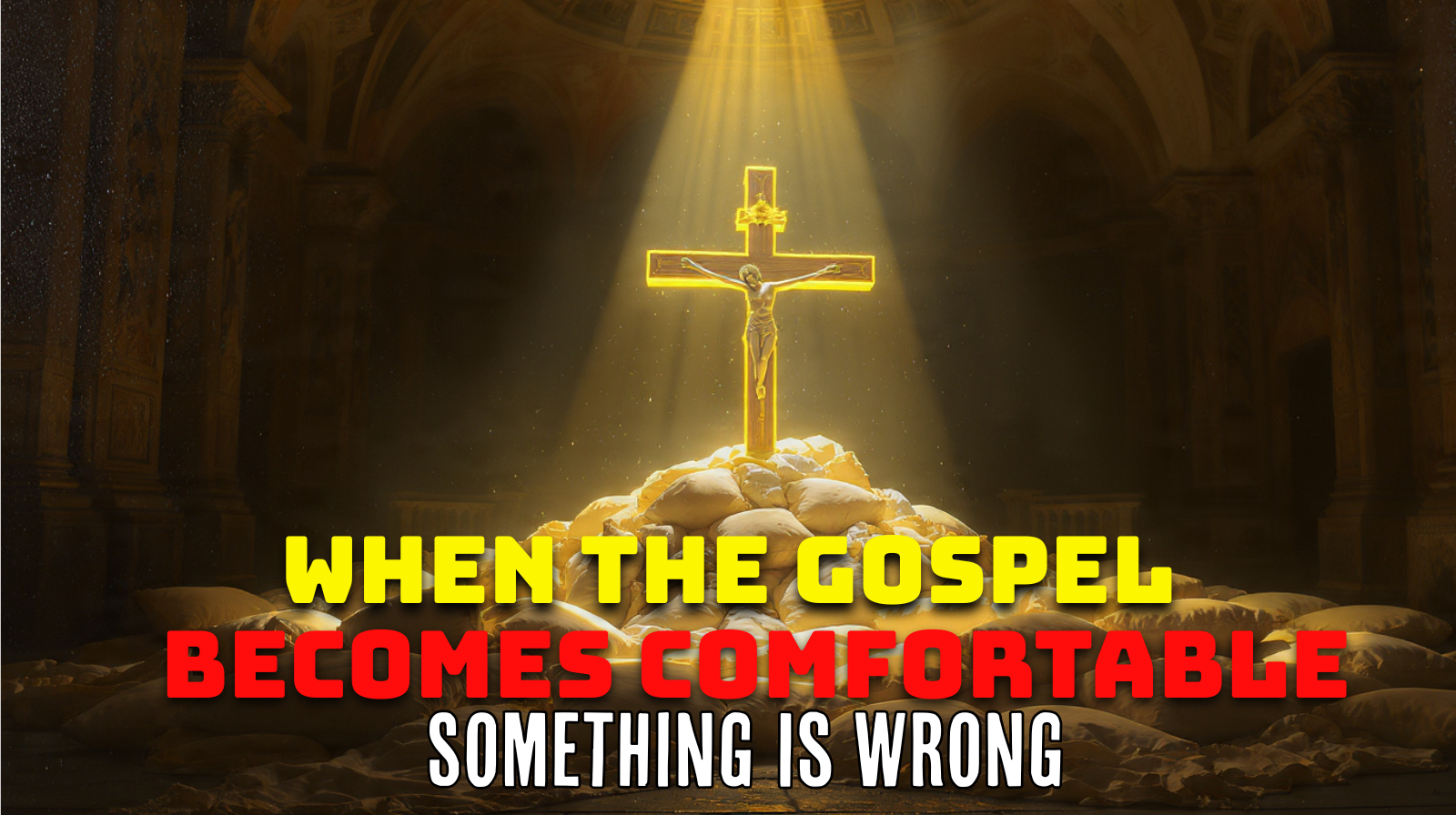
When the Gospel Becomes Comfortable, Something Is Wrong
When the Gospel Becomes Comfortable, Something Is Wrong
There is a seduction that has crept into the modern church, a subtle and intoxicating whisper that suggests Christianity is meant to be a safe harbor for our personal happiness rather than a launchpad for divine mission. We have inadvertently reconstructed the rugged, blood-stained cross of Calvary into a cushioned recliner. We attend services that are designed to offend no one, listen to sermons that are calibrated to affirm our lifestyle rather than challenge our sins, and construct a theology that views God primarily as a cosmic butler whose job is to ensure our comfort and prosperity. We have traded the roar of the Lion of Judah for the purr of a domesticated pet. But when we open the pages of the New Testament, we are confronted with a starkly different reality. The Gospel that Jesus preached was not safe; it was revolutionary. It did not bring comfort to the flesh; it brought a sword to the spirit. It disrupted the status quo, challenged the religious elite, and demanded a surrender so total that it was described as a form of execution—"take up your cross and follow me." If your walk with God has become predictable, safe, and entirely comfortable, it is not a sign that you have arrived; it is a warning sign that you may have drifted. A comfortable Gospel is a counterfeit Gospel. It lacks the power to save because it lacks the power to transform. And before we dive in, if this message is already stirring something in you, hit the subscribe button and stay connected to God's Word daily, because we believe that truth sets us free. The very nature of light is that it conflicts with darkness. The very nature of salt is that it stings an open wound before it preserves. If we are truly living as light and salt in a fallen world, friction is inevitable. Comfort usually implies that we have made a peace treaty with the world, a compromise that allows us to blend in rather than stand out. Today, we are going to strip away the cushions we have placed around our faith. We are going to look at the seven dangerous signs that your Christianity has become too comfortable, and we will rediscover the wild, dangerous, and glorious call of the true Gospel. This is a call to wake up from the spiritual anesthesia of comfort and step back onto the battlefield of faith.
The tragedy of a comfortable faith is that it insulates us from the very power of God we claim to seek. We read stories in the Bible about seas parting, lions' mouths being shut, and dead men rising, and we wonder, "Where is that power today?" The answer is that those miracles happened in the context of extreme danger and discomfort. You don't need a sea to part if you are sitting on the beach. You don't need a lion's mouth shut if you are at the zoo. You don't need a resurrection if you aren't willing to die to yourself. God’s power is reserved for those who step out of the boat, for those who risk their reputation, their security, and their comfort for the sake of His name. Comfort acts as a dampener on the Holy Spirit. It tells God, "I trust You as long as it doesn't hurt, as long as it doesn't cost me anything." But love is measured by cost. "For God so loved the world that He gave..." The Gospel is a story of extravagant giving, of bleeding, of dying, and of rising. It is high time we stopped trying to domesticate the Gospel and started letting it wild in our hearts again. We need to become comfortable with being uncomfortable, for that is where the glory lives. Let us examine the evidence of a compromised, comfortable faith and how to reignite the fire.
Number 1: The Cross vs. The Couch — The Call to Die
The most fundamental error of the "Comfortable Gospel" is a misunderstanding of the invitation of Jesus. The modern invitation often sounds like this: "Come to Jesus, and He will fix your marriage, balance your checkbook, and give you peace of mind." While God certainly cares about those things, that was not the recruitment speech of Christ. Jesus said, "If anyone would come after me, let him deny himself and take up his cross daily and follow me" (Luke 9:23). The cross, in the first century, was not a piece of jewelry. It was not a logo for a hospital. It was an instrument of torture and execution. It was a symbol of death. When Jesus told a crowd to "take up their cross," He was saying, "Come and die." He was calling them to a death of their will, their ego, and their right to self-determination. A corpse has no rights. A corpse does not get offended. A corpse does not demand comfort.
When the Gospel becomes comfortable, we replace the Cross with the Couch. The Couch represents a life where our primary goal is to be at ease. We judge a church service by whether the seats were soft and the coffee was hot, not by whether the Word cut us to the heart. We judge a sermon by whether it made us feel good, not whether it made us holy. We start to view God as a means to our comfort rather than the object of our worship. We think, "If God loves me, He won't let me suffer." But this ignores the reality that God loved His own Son perfectly, yet "it pleased the Lord to bruise Him" (Isaiah 53:10) for the sake of redemption. The Couch theology produces Christians who are spiritually flabby, unable to withstand the slightest pressure, and quick to quit when the Christian life gets hard.
The Cross, however, kills the flesh. The flesh is that part of us that screams for gratification, for safety, and for recognition. A comfortable Gospel feeds the flesh; the true Gospel crucifies it. Paul said, "I have been crucified with Christ. It is no longer I who live, but Christ who lives in me" (Galatians 2:20). Notice the tense—crucified. Past tense. But it is also a daily reality. Every day, we have to climb back on that altar. When you want to snap at your spouse, you choose the cross of patience. When you want to hoard your money, you choose the cross of generosity. When you want to hide in silence, you choose the cross of witnessing. This is uncomfortable. It hurts. But it is the pain of surgery, not the pain of injury. It is the pain of the old self dying so the new self can rise.
The comfortable Gospel lies to you by telling you that you can have the resurrection without the crucifixion. It promises the crown without the thorns. But there is no shortcut to glory. The grain of wheat must fall into the ground and die, or else it abides alone. If you are clinging to your life—your comfort, your plans, your control—you will lose it. But if you lose your life for His sake, you will find it. Real life, abundant life, is found on the other side of the death of your comfort. We must reject the theology of the Couch and embrace the theology of the Cross. We must be willing to be inconvenienced, to be stretched, and to be spent for the sake of the Kingdom.
Number 2: The Friction of Holiness
A major sign that the Gospel has become too comfortable in your life is the absence of friction with the world around you. Jesus made a definitive statement in John 15:19: "If you were of the world, the world would love you as its own; but because you are not of the world, but I chose you out of the world, therefore the world hates you." This is spiritual physics. When two objects are moving in opposite directions, friction occurs. If you are moving toward God and the world is moving toward destruction, there should be a collision. There should be heat. There should be resistance. If your life fits perfectly into the jigsaw puzzle of secular culture, it is because you have likely changed your shape to fit in.
Holiness is, by definition, "set apartness." It means being cut from a different cloth. In a culture that celebrates greed, a holy person is generous. In a culture that celebrates lust, a holy person is pure. In a culture that celebrates revenge, a holy person forgives. This difference irritates the world. Light irritates people who are trying to sleep in the dark. If you are living a holy life, you will make people uncomfortable—not because you are being rude, but because your life acts as a mirror that exposes their sin. If you never experience this friction—if everyone at work loves you, agrees with you, and feels totally affirmed by you in their sin—then your salt has lost its savor.
The comfortable Gospel removes the friction by redefining holiness. It lowers the bar. It says, "God understands we are human," which becomes code for "God doesn't mind if we live exactly like pagans as long as we go to church on Sunday." We adopt the world's entertainment, the world's language, the world's sexual ethics, and the world's priorities. We become "chameleons"—changing our colors to match our environment. This makes life very comfortable. We get invited to the parties. We get the promotions. We avoid the awkward silence when a dirty joke is told. But we also lose our power. A chameleon can hide, but it cannot lead.
If this message inspires you, don't forget to subscribe for more Bible insights every week. We need to recover the "offense" of the Cross. The Gospel is offensive to the natural mind. It tells people they are sinners in need of a Savior. It tells people they are wrong. You cannot preach a Gospel that saves people from sin if you are terrified of mentioning sin. We must be willing to be the "aroma of death" to those who are perishing, as Paul says, so that we can be the "aroma of life" to those who are being saved. Stop trying to be cool. Stop trying to be relevant. Be holy. Holiness is the most relevant thing in the world because it is the one thing the world cannot produce on its own. Embrace the friction. It proves you are moving against the current.
Number 3: The Danger of a Muted Conscience
One of the most terrifying byproducts of a comfortable Gospel is the gradual muting of the conscience. The conscience is the alarm system of the soul. When we sin, the Holy Spirit triggers the conscience to produce guilt and conviction. This guilt is good; it is the pain that tells us to pull our hand away from the fire. It drives us to repentance. But when we prioritize comfort, we begin to view guilt as the enemy. We want to feel "good" all the time. So, instead of repenting to remove the guilt, we ignore the warning. We justify the sin. We rationalize. We compare ourselves to others. "At least I'm not as bad as him."
Over time, this repeated ignoring of the conscience creates a callous. 1 Timothy 4:2 speaks of those whose "consciences have been seared as with a hot iron." A seared conscience feels nothing. It can commit sins that used to make it weep, and now it doesn't even blink. You can gossip without a check in your spirit. You can watch impurity without looking away. You can hold a grudge without losing sleep. This is the ultimate "comfort"—the comfort of a spiritual coma. You are comfortable in your sin because your nerve endings have been burned off.
A comfortable Gospel aids this process by preaching only "positive" messages. It avoids the topics of judgment, hell, wrath, and repentance. It acts as a painkiller, masking the symptoms of the soul's disease without curing it. We sit in church week after week, feeling affirmed but never convicted. We leave thinking we are fine when we are actually dying. God's mercy is often found in the sermons that make us squirm, the verses that cut us, and the conviction that brings us to our knees.
To wake up from this, we must invite the Holy Spirit to re-sensitize us. We need to pray the prayer of David: "Search me, O God, and know my heart! Try me and know my thoughts! And see if there be any grievous way in me" (Psalm 139:23-24). We need to ask God to break our hearts for what breaks His. We need to stop running from conviction and start running toward it. The pain of conviction is the proof of God's love; He loves you too much to let you stay comfortable in a sin that is destroying you. A tender conscience is a precious gift; fight to keep it soft.
Number 4: The Idol of Safety
For many modern believers, "safety" has become a god. We make all our decisions based on risk management. We choose our careers based on safety, our neighborhoods based on safety, and our ministries based on safety. We cloak this in spiritual language—we call it "stewardship" or "wisdom"—but often it is simply fear wrapped in religion. We think that if we are in the will of God, we will be safe. But the Bible does not support this. Was David safe when he fought Goliath? Was Daniel safe in the lion's den? Was Paul safe when he was shipwrecked? Was Jesus safe on the cross?
The comfortable Gospel reinforces the Idol of Safety. It tells us that God exists to protect us from all harm and discomfort. So, when God calls us to do something dangerous—to go to a difficult mission field, to foster a troubled child, to give away our savings, to speak truth to power—we reject it. We say, "God wouldn't want me to put my family at risk." We confuse the American Dream with the Kingdom of God. We forget that we follow a Lion, not a kitten. As C.S. Lewis wrote of Aslan, "Safe? Who said anything about safe? 'Course he isn't safe. But he's good. He's the King, I tell you."
When we worship safety, we become paralyzed. We never take the step of faith because we can't see the whole staircase. We never release the seed because we are afraid of the famine. We become hoisters of talents, like the wicked servant in Matthew 25, who buried his talent because he was "afraid." He played it safe, and he was judged for it. Faith is spelled R-I-S-K. If you can see how it's going to work out, it doesn't require faith. God is calling us to leave the shores of safety and launch out into the deep.
If this message inspires you, don't forget to subscribe for more Bible insights every week. The safest place in the universe is not in a bunker; it is in the center of God's will. You are safer in a storm with Jesus than in a calm boat without Him. We must smash the idol of safety. We must be willing to look foolish, to lose money, to lose reputation, and even to lose our lives for the sake of the Gospel. "For whoever would save his life will lose it, but whoever loses his life for my sake will find it" (Matthew 16:25). A comfortable life is a wasted life. A dangerous life for God is an eternal investment.
Number 5: The Loss of Evangelistic Urgency
Perhaps the most tragic consequence of a comfortable Gospel is the loss of tears for the lost. When we are comfortable, we become insulated. We live in our Christian bubbles, listen to our Christian music, go to our Christian clubs, and ignore the dying world outside our windows. We lose the reality of Hell. We stop believing that people are actually perishing. We adopt a functional universalism that says, "Well, God is good, surely He won't send my nice neighbor to hell." This lie allows us to sleep at night while our neighbors are sleepwalking toward the cliff.
Comfort makes us selfish. Evangelism is uncomfortable. It is awkward. You risk rejection. You risk looking like a fanatic. You have to intrude on someone's life. A comfortable Christian says, "I'll just witness with my life," which usually means "I will be nice and hope they guess I'm a Christian." But faith comes by *hearing*. Someone has to open their mouth. Someone has to break the social contract of silence. Paul said, "Woe to me if I do not preach the gospel!" (1 Corinthians 9:16). He felt a burning necessity.
Look at the story of Jonah. He was the quintessential comfortable prophet. God told him to go to Nineveh, a wicked and dangerous city. Jonah said "No" and went to Tarshish. He went down into the boat and fell into a "deep sleep." While the pagan sailors were screaming for their lives in the storm, Jonah was sleeping. This is a picture of the modern church. The world is in a storm of chaos, confusion, and darkness, and the church is asleep in the basement, comfortable in its rebellion. We need a wake-up call. The captain woke Jonah and said, "What do you mean, you sleeper? Arise, call out to your god!" The world is shaking us, asking for answers, and we are groggy.
We need to recover the urgency of the lifeboat. If you were on the Titanic and you made it to a lifeboat, you wouldn't sit back and relax; you would be scanning the water for survivors. You would be pulling people in until the boat was full. We are the survivors. The world is the Titanic. We cannot be content to just sing hymns in the lifeboat while people drown. We must get uncomfortable. We must risk the awkward conversation. We must plead with men to be reconciled to God. Comfort says, "They are fine." The Gospel says, "Rescue the perishing."
Number 6: The Theology of Suffering
The comfortable Gospel has no category for suffering other than as an enemy to be defeated. When trouble comes—sickness, financial loss, persecution—the comfortable Christian panics. They think, "God has abandoned me," or "My faith isn't working." They have been taught that if they do X, Y, and Z, God is obligated to give them a smooth life. This is a "vending machine" theology. But the Bible teaches a theology of suffering that says trials are not accidents; they are appointments. They are the gymnasium of the soul.
James 1:2 says, "Count it all joy, my brothers, when you meet trials of various kinds." Why? Because the testing of your faith produces steadfastness. Suffering is the crucible where faith is purified. You cannot learn endurance in a hammock. You cannot learn courage without danger. You cannot learn to trust God for your daily bread until you are hungry. The comfortable Gospel robs us of these lessons. It tries to drug the pain instead of learning from it. But God uses pain. He uses the thorn in the flesh to keep Paul humble. He uses the prison to produce the Epistles. He uses the cross to produce the crown.
When we flee from all discomfort, we remain spiritual infants. We are like children who want to eat candy but refuse to eat their vegetables. We want the sweet blessings, but we reject the nutritious discipline. Hebrews 5:8 says even Jesus "learned obedience through what he suffered." If the Son of God was matured through suffering, how do we expect to mature through luxury? We need to embrace the difficult seasons not as signs of God's absence, but as signs of His pruning hand. He cuts us so we can bear more fruit.
This doesn't mean we look for suffering or enjoy it (that’s masochism). It means we don't waste it. It means we don't let the pursuit of comfort dictate our obedience. We are willing to suffer *with* Him so that we may also be glorified *with* Him (Romans 8:17). We realize that the light and momentary afflictions are preparing for us an eternal weight of glory. A comfortable life prepares you for nothing. A challenged life prepares you for eternity.
Number 7: The Lukewarm Warning
The final and most terrifying warning against comfortable Christianity comes from the lips of Jesus Himself in Revelation 3:15-16, addressed to the church in Laodicea. Laodicea was a wealthy, comfortable banking center. The church there reflected the city. They said, "I am rich, I have prospered, and I need nothing." They were comfortable. They weren't cold (openly rejecting God), but they weren't hot (on fire for God). They were lukewarm. And Jesus' reaction to them was visceral: "Because you are lukewarm, and neither hot nor cold, I will spit you out of my mouth."
The word "spit" is polite; the Greek implies "vomit." Lukewarmness makes God sick. Why? Because it is an insult to His love. If God were a small, boring deity, a lukewarm response would be appropriate. But He is a Consuming Fire. He gave everything—His only Son—for us. To respond to that blazing sacrifice with a casual shrug, a half-hearted attendance, and a "comfortable" faith is deeply offensive. It says, "You are worth a little of my time, but not all of it."
The Laodiceans were blinded by their comfort. Jesus told them, "You do not realize that you are wretched, pitiable, poor, blind, and naked." Comfort blinds us to our true spiritual condition. We think our material success is a sign of spiritual health. We think because we have no problems, we have God's favor. But Jesus tells them to buy from Him gold refined in the fire—true character forged in heat. He tells them to put on eye salve—to see their need.
This is the ultimate danger: You can be comfortable all the way to hell. You can sit in a pew for 40 years, never be challenged, never be persecuted, never risk anything, and hear "Depart from me" at the end. We must heat up. We must stoke the fires of our first love. We must repent of our apathy. God would rather you be cold—an honest atheist—than a lukewarm Christian who inoculates the world against the truth. Let us be hot. Let us be fervent. Let us be on fire.
Conclusion
We have looked into the mirror of the Word, and the reflection is sobering. The call of Christ is not a call to a vacation; it is a call to a vocation—a vocation of war, of love, and of sacrifice. We have seen that the Cross opposes the Couch, that Holiness creates Friction, and that Safety is an Idol. We have been warned against the Muted Conscience, the Loss of Evangelistic Zeal, and the Lukewarm spirit.
If you feel conviction today, that is a mercy. It is the Holy Spirit shaking you awake. Do not hit the snooze button. Do not go back to sleep. The hour is late, and the King is coming. It is time to get uncomfortable. It is time to have the hard conversations, to give until it scares you, to pray until you sweat, and to love until it hurts.
Let us trade our cushions for armor. Let us trade our ease for the adventure of following the Lamb wherever He goes. The comfortable life is a mirage; it leaves you thirsty. The surrendered life is a river; it flows into eternity. Step out of the boat. The water is choppy, the wind is high, but the Savior is walking there. And He is worth every risk.
Before you go, make sure to subscribe, like this video, and share it with someone who needs encouragement today. And join us next time as we uncover another powerful truth from God's Word.
Community Discussion
Please sign in with Google to share your thoughts.
No comments yet. Be the first to start the conversation!