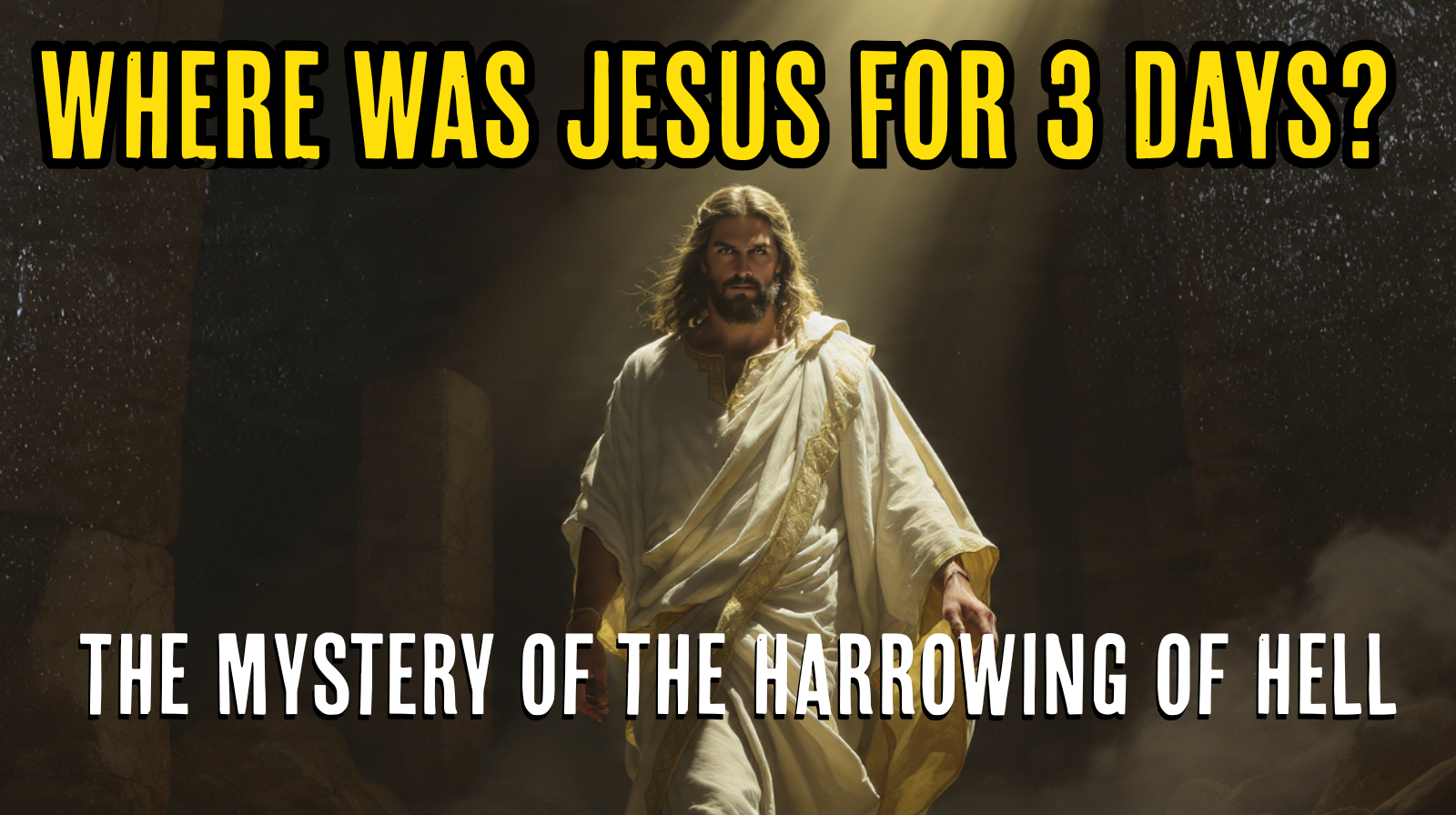
Where Was Jesus for 3 Days? The Mystery of the Harrowing of Hell
Where Was Jesus for 3 Days? The Mystery of the Harrowing of Hell
We talk endlessly about Good Friday. We weep over the cross, the nails, the crown of thorns, and the blood. We celebrate Easter Sunday with trumpets, lilies, and shouts of "He is Risen!" But there is a day in between that the modern church rarely discusses. It is Holy Saturday. The day of silence. The day Jesus’ body lay cold and stiff in the rock-hewn tomb of Joseph of Arimathea.
But while His body was resting in the tomb, where was His Spirit? Was He simply "asleep"? Was He floating in a cosmic void? Was He in Heaven? The Apostles’ Creed, recited by believers for nearly two thousand years, includes a line that makes many of us uncomfortable and confused: *"He suffered under Pontius Pilate, was crucified, died, and was buried. He descended into hell."*
Why? Why did the Holy Son of God have to descend into the darkest place in the universe? Did He go there to suffer more? Did He go there to fight? Did He go there to rescue someone?
This event is known by theologians as "The Harrowing of Hell." It is one of the most mysterious, controversial, and yet victorious chapters in the entire Bible. It changes everything about how we view death.
Many Christians have a sanitized view of Easter. We think Jesus died, pressed "pause" for three days, and then woke up. But the Bible paints a much more aggressive picture. It wasn't a nap; it was a mission. Jesus didn't go to the underworld as a victim; He went as an Invader. He didn't go to serve a sentence; He went to serve an eviction notice.
Today, we are going to grab a flashlight and descend into the mystery of those three days. We are going to look at the "Geography of the Underworld," the "Seizure of the Keys," and the "Great Jailbreak." We are going to discover that the greatest battle of history wasn't fought on the earth, but *under* it.
Number 1: The Geography of the Underworld (Sheol vs. Gehenna)
To understand why Jesus went down, and where exactly He went, we have to fix our translation of the word "Hell." In English, we use the word "Hell" as a blanket term for the bad place. But the Bible uses distinct words that mean different things.
* Gehenna (The Lake of Fire): This is the place of final judgment. This is where the Beast, the False Prophet, and Satan will ultimately be cast at the end of time (Revelation 20). Jesus did not go here. In fact, nobody is there yet. It is currently empty.
* Sheol (Hebrew) / Hades (Greek): This was the "Abode of the Dead." Before the resurrection of Christ, *everyone* who died—good or bad—went to Sheol. It was the holding tank of the departed.
But Jesus reveals a fascinating detail in Luke 16, in the story of the Rich Man and Lazarus. He pulls back the curtain on Sheol and shows us that it had two compartments, separated by a "Great Gulf" that no one could cross.
1. The Place of Torment: This is where the unrighteous (like the Rich Man) waited in agony.
2. Abraham’s Bosom (Paradise): This is where the righteous (like Lazarus, Abraham, David, Moses) waited in comfort.
Why were the righteous in a holding tank? Why weren't they in Heaven with God? Because the blood of bulls and goats (Old Testament sacrifices) could cover sin, but it couldn't *remove* sin (Hebrews 10:4). The debt hadn't been fully paid yet. The door to the Throne Room was still shut to humanity. The Old Testament saints were saved, but they were "on hold," waiting for the Messiah to open the gate.
Jesus had to go to Sheol because that is where His friends were. He went to the "Paradise" section of the underworld.
Number 2: The Mission of Victory — Not Suffering
There is a dangerous teaching that suggests Jesus went to hell to be tortured by demons for three days to "finish" the payment for sin. This is theologically false.
On the Cross, just before He died, Jesus cried out, "It is finished" (John 19:30). The Greek word is *Tetelestai*, which means "Paid in Full." The wrath of God was satisfied on the Cross, not in hell. The atonement was completed on the wood, not in the fire.
So, if He didn't go to suffer, why did He go? He went to Conquer.
Colossians 2:15 gives us the picture: *"And having disarmed the powers and authorities, he made a public spectacle of them, triumphing over them by the cross."*
The language here is drawn from a Roman Military Triumph. When a General won a war, he would return to Rome in a parade. He would strip the enemy kings of their armor and drag them in chains behind his chariot to show the world they were defeated.
Jesus descended into the underworld not as a Prisoner of War, but as the Special Forces Commander. He walked right into Satan's headquarters. He walked past the principalities and powers. He stripped them of their authority. He went to show the powers of darkness that their greatest weapon—Death—had just been broken by a man who could not be held by it.
Number 3: The Seizure of the Keys (The Transfer of Authority)
In Revelation 1:18, the Risen Jesus appears to the Apostle John and makes a stunning declaration: *"I am the Living One; I was dead, and now look, I am alive for ever and ever! And I hold the keys of death and Hades."*
How did He get those keys? He took them.
Hebrews 2:14 tells us that Satan "held the power of death." For thousands of years, the Devil was the jailer. Every time a human died, Satan could claim legal authority over them because of the curse of sin. He held the keys that locked the gates of the grave from the inside.
When Jesus died, He entered the jail. But here was the problem for Satan: Jesus had no sin. The wages of sin is death, but Jesus had earned Life. It was illegal for the grave to hold a sinless man. The system crashed.
Jesus turned the tables on the jailer. He wrestled the keys of authority from the enemy’s hand.
Possessing keys means possessing Authority.
* Because He holds the keys, Satan can no longer determine when you die; only Jesus can.
* Because He holds the keys, the grave is no longer a prison for the believer; it is a passageway.
He had to go down to transfer the administration of death from the Devil to Himself.
Number 4: The Great Jailbreak (Leading Captivity Captive)
This is perhaps the most beautiful reason for His descent. Ephesians 4:8 says: *"When he ascended on high, he took many captives..."* (quoting Psalm 68:18).
Who were these captives? They were the Old Testament saints waiting in "Abraham’s Bosom."
Imagine the scene. For thousands of years, Adam, Eve, Noah, Abraham, David, Isaiah, and Daniel were waiting. They had the promise of God, but they hadn't seen the fulfillment. They were safe, but they were still in the underworld. They were waiting for the Seed of the Woman to crush the Serpent's head.
Suddenly, on that Holy Saturday, a brilliant light pierces the darkness of Sheol. The gates are ripped off their hinges. And there stands the Messiah, holding the keys, with the scars on His hands.
He says to them, "The debt is paid. The blood has been shed. The road to the Father is paved. Pack your bags. We are leaving this place."
Jesus emptied the "Paradise" section of Hades. He took the saints out of the holding tank and marched them straight into the Third Heaven. He moved Paradise from the basement to the penthouse.
He had to go down to get them. He wasn't going to leave His faithful servants in the waiting room a moment longer than necessary.
Number 5: The Proclamation to the Spirits (The Victory Lap)
1 Peter 3:19 adds another mysterious layer to this journey: *"After being made alive, he went and made proclamation to the imprisoned spirits."*
Who are these "imprisoned spirits"? Most biblical scholars believe these are not human souls, but the fallen angels from the days of Noah (Genesis 6), who rebelled against God and were bound in chains of darkness (Jude 1:6).
Notice the text says He made a "Proclamation." The Greek word is *kerygso* (to herald or announce), not *euangelizo* (to preach the gospel for salvation).
Jesus didn't go to save these demons; they are beyond redemption. He went to Announce His Victory.
He went to the deepest, darkest dungeon of the demonic realm—Tartarus—to look the rebellious spirits in the eye and say: "You thought you won by killing Me. You thought you could stop the plan of God. But you failed. I have won. Your doom is sealed."
It was a cosmic victory lap. Philippians 2:10 says that at the name of Jesus every knee should bow, "in heaven and on earth and under the earth." He had to go down to ensure that even the demons under the earth bowed the knee to His Lordship.
Number 6: The Sign of Jonah (The Legal Proof)
Jesus predicted this specific timeframe in Matthew 12:40: *"For as Jonah was three days and three nights in the belly of a huge fish, so the Son of Man will be three days and three nights in the heart of the earth."*
Jonah was swallowed by death. He went down to the "roots of the mountains" (Jonah 2:6). But the fish couldn't digest him. It had to vomit him out.
Jesus had to go into the "heart of the earth" to fulfill the prophecy. The earth swallowed the Creator, but it got a bad case of indigestion. It couldn't consume Him. It had to release Him.
This 3-day period was also the legal timeframe in Jewish tradition to prove someone was truly dead. They believed the spirit hovered near the body for three days. By staying down for three full days, Jesus proved that His resurrection wasn't a resuscitation or a recovery from a coma. It was a total conquest of death itself. He fully died, and He fully rose.
Number 7: Why It Matters For You — The Fear of Death is Gone
Why does this theology matter to you today? Why should you care about what happened in the dark 2,000 years ago?
Because you don't have to go there.
Before Christ, death was a terrifying one-way trip into the gloom of Sheol. Even for the righteous, it was a place of shadows and waiting. But because Jesus went there, conquered it, and ripped the doors off, the destination for the believer has changed.
We do not go to Hades. We do not go to a holding tank.
The Apostle Paul says in 2 Corinthians 5:8, *"To be absent from the body is to be present with the Lord."*
When a Christian dies today, they bypass the underworld entirely. They go straight to the Throne Room.
Jesus went through the horror of the darkness so you could walk straight into the light.
He took the elevator down to the basement so He could bring you up to the throne.
He faced the cold isolation of death so that you could look at the grave and say, *"Where, O death, is your victory? Where, O death, is your sting?"* (1 Corinthians 15:55).
Conclusion
The descent of Jesus was not a tragedy; it was the greatest rescue mission in history.
He invaded the enemy’s territory.
He disarmed the demonic powers.
He seized the keys of authority.
He liberated the waiting saints.
And He paved the highway to Heaven.
So, when you think of Jesus, don't just picture Him on the Cross, and don't just picture Him standing by the empty tomb. Picture Him in the dark, kicking down the gates of hell, staring the enemy in the face, and saying, "Give Me those keys. I'll take it from here."
You serve a Savior who has conquered the grave from the inside out. Be fearless today.
(Revelation 1:18) "I am the Living One; I was dead, and now look, I am alive for ever and ever! And I hold the keys of death and Hades."ban
Community Discussion
Please sign in with Google to share your thoughts.
No comments yet. Be the first to start the conversation!